

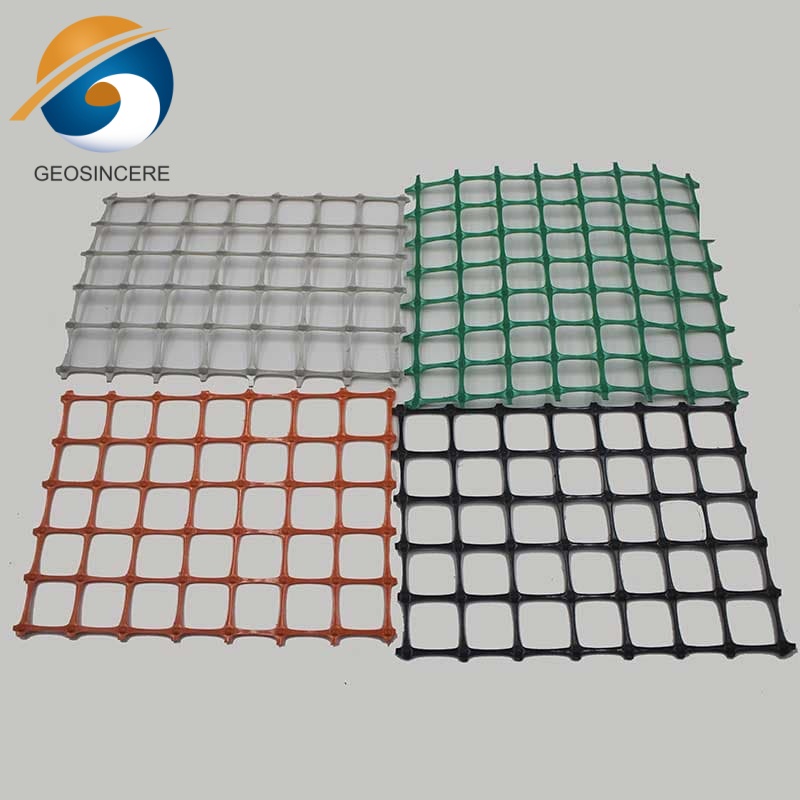
Geogrid for Gravel
Stop wasting money on shifting gravel and failing driveways. Our geogrid for gravel is the ultimate base-stabilization solution designed to lock aggregate permanently in place. By transforming a localized wheel load into a widespread horizontal footprint, it prevents deep ruts, stops gravel from sinking into the mud, and eliminates the need for constant maintenance. Whether you are building a commercial parking lot, a heavy-duty driveway, or a residential patio, this grid turns unstable soil into a solid, engineered platform instantly.
- 300% Load Boosting: Distributes heavy vehicle weight horizontally to eliminate rutting and base failure.
- Cut Aggregate Costs by 40%: Requires significantly less gravel thickness to achieve a high-bearing load rating.
- 100% Porous & Permeable: Allows rapid water drainage to eliminate puddles and prevent gravel washouts during storms.
- Fast, Flat-Laying Installation: Engineered with rigid memory to unroll and lie completely flat, saving up to 30% on labor costs.
- 50+ Years Durability: Manufactured from 100% virgin polymer; highly resistant to UV, underground acids, and extreme weather (-50℃ to 60℃).
1. Geogrid for Gravel Driveways Parking Lots and Base Stabilization
- Say Goodbye to Shifting Gravel, Rutting, and Base Failure
Are you tired of gravel driveways that constantly develop deep ruts after a few heavy rains? Or base soils so soft that your expensive gravel aggregates just sink straight into the mud?
Our Premium Biaxial Geogrid for Gravel is engineered to turn unstable ground into a rock-solid, heavy-duty load-bearing platform. By locking aggregate securely in place, it stops gravel migration, prevents deep ruts, and drastically reduces long-term maintenance.
- Cut Aggregate Costs by up to 40% (Requires less gravel thickness)
- Boost Load Capacity by 300% (Handles heavy trucks, pickups, and RVs)
- Fast, DIY-Friendly Installation (No heavy machinery required to roll out)

2. The Real Problems with Gravel Projects (And How We Fix Them)
Whether you are a professional contractor trying to pass a commercial inspection or a property owner building a backyard parking pad, gravel on raw soil always behaves the same way:
2.1 The Sinking Money Pit:
Without a stabilizer, heavy vehicle tires push gravel downward and outward. Over time, your expensive gravel disappears into the subgrade, forcing you to top it off year after year.
2.2 The Muddy Nightmare:
Heavy rain softens the dirt underneath. When trucks drive over it, the mud pumps upward, mixing with your clean gravel and ruining the driveway's look and structure.
2.3 Wasted Labor & Materials:
To make a driveway "strong," standard practice is to dig deeper and pour thick layers of gravel. This means skyrocketing material bills, higher trucking fees, and days of extra labor.
3. Geogrid for Gravel The Mechanics: How It Works
Our geogrid doesn't just sit under the gravel—it dynamically interacts with it.
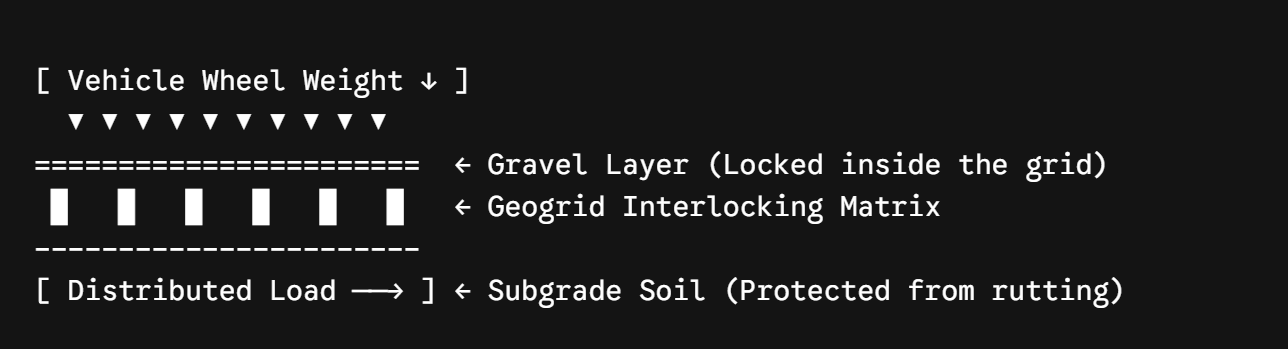
3.1 The Interlocking Effect:
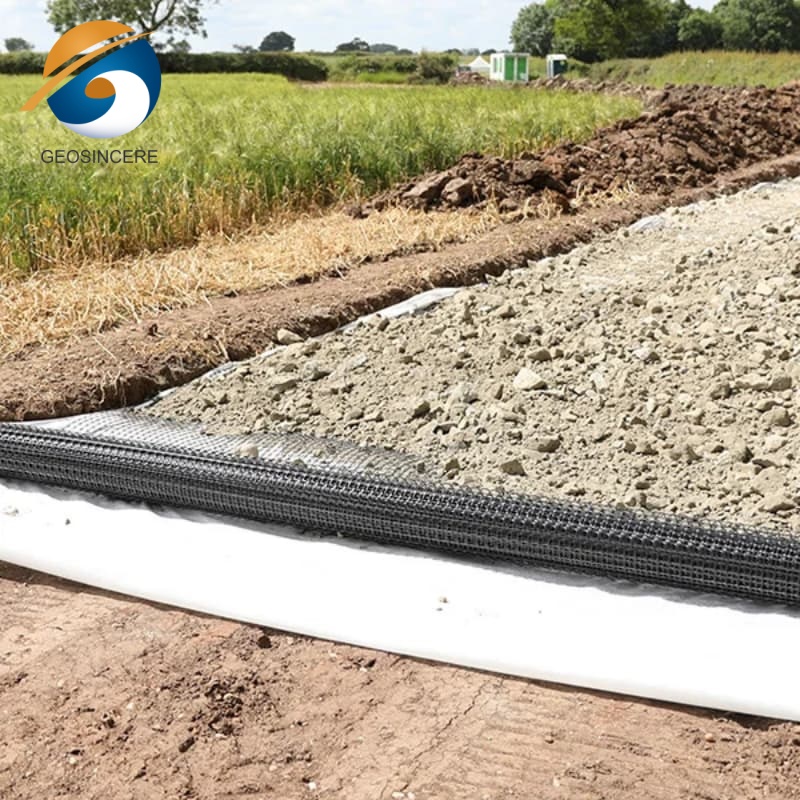
The rigid ribs and strong junctions of our geogrid act as millions of "miniature anchors." When gravel is dumped onto the grid, the stones lock tightly into the apertures (aperture size perfectly optimized for 20-40mm stones).
3.2 Snowshoe Load Distribution:
Instead of allowing a heavy tire to concentrate all its pressure on one weak spot, the geo grid for gravel distributes the weight horizontally across a massive surface area—much like a snowshoe prevents you from sinking into deep snow.
4. Geogrid for Gravel Superior Drainage & Eco-Friendly Benefits
4.1 100% Permeability: Say Goodbye to Puddles and Washouts
Traditional concrete or asphalt driveways block rainwater, leading to severe localized flooding, soil erosion, and costly storm-water management compliance issues. Our geogrid configuration creates a 100% porous and permeable pavement system:
4.2 Instant Drainage:
Rainwater passes straight through the gravel and the geogrid apertures, naturally recharging the groundwater without creating surface puddles.
4.3 Erosion Control:
Even during torrential downpours or flash floods, the interlocked gravel matrix stays locked in place, preventing the aggregate from being washed away down slopes.
5. Why Choose Our GEOSINCERE Geosynthetics Geogrid for Gravel? (The Competitive Edge)
Not all grids are created equal. Here is how our premium gravel stabilizer outperforms cheap, lightweight alternatives on the market:
Feature | Cheap / Recycled Plastic Grids | Our Premium Virgin HDPE/PP Geogrid |
Material Quality | Made from low-grade recycled plastics. Brittle in winter, soft and sagging in summer. | 100% Virgin High-Density Polymer. Chemically inert, resists acids/alkalis, and lasts 50+ years underground. |
Junction Strength | Weak welded joints that snap under the weight of heavy dump trucks spreading gravel. | Integrally punched and drawn (or ultrasonic high-strength welded). Junctions won't tear under intense stress. |
Roll Stiffness | Floppy and rolls back up automatically during installation. Requires 3-4 crew members just to hold down. | Engineered Rigid Memory. Lies flat instantly when unrolled. One person can lay out 100 meters easily, saving 30% on labor. |
Aggregate Savings | Low structural integrity requires you to still use 6–8 inches of gravel. | Reduces the required gravel base thickness by up to 40% while achieving superior load ratings. |
6. Geogrid for Gravel Product Specifications & Selection Guide
To make procurement easy, we offer two distinct grades depending on your project's traffic demands:
6.1 Medium-Duty Grade (Residential & Light Commercial)
- Best For: Residential driveways, patio bases, walkways, golf cart paths, and garden trails.
- Material: Biaxial Polypropylene (PP) / Light HDPE
- Tensile Strength: $15 \times 15\text{ kN/m}$ to $20 \times 20\text{ kN/m}$
- Aperture Size: Approx. $35\text{ mm} \times 35\text{ mm}$ (Ideal for standard #57 or angular angular crushed stone)
6.2 Ultra Heavy-Duty Grade (Industrial & Civil Engineering)
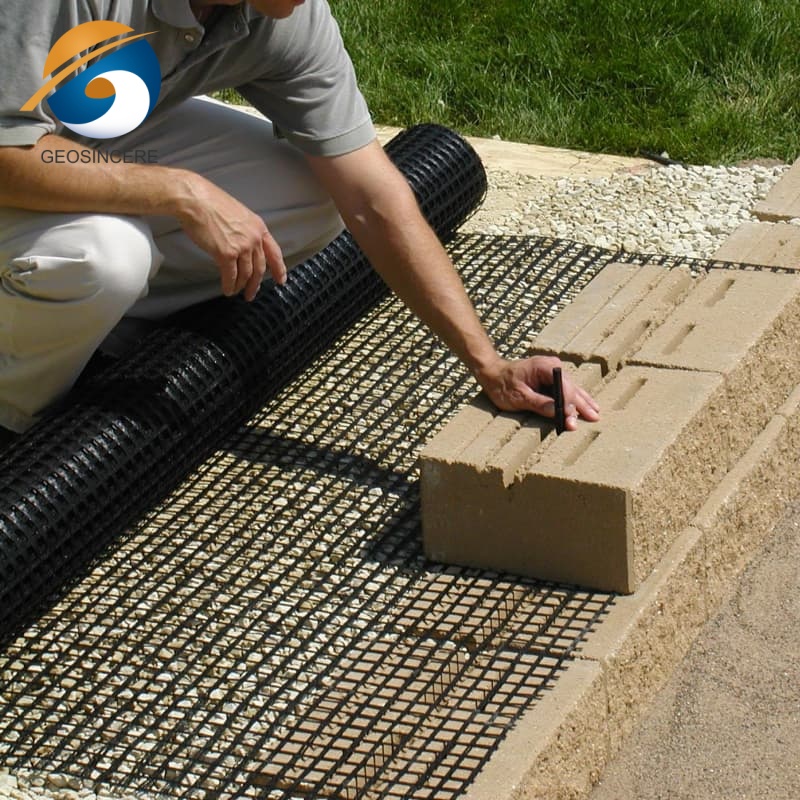
- Best For: Semi-truck parking lots, heavy equipment access roads, fire lanes, mud/swamp stabilization, and retaining wall reinforcement.
- Material: High-Tensile Virgin PP / Cellular 3D Geocell
- Tensile Strength: $30 \times 30\text{ kN/m}$ to $50 \times 50\text{ kN/m}$
- Aperture Size: $40\text{ mm} \times 40\text{ mm}$ (Handles larger ballast and heavy subgrade friction)

7. Advanced Solution: Geogrid-Geotextile Combi-Rolls
Got Ultra-Soft Clay or Muddy Soil? Upgrade to Our 2-in-1 Geo-Composite
If your project site sits on soft clay, marshland, or highly saturated subgrade, standard grids might let fine mud particles pump up into your clean gravel over time. We offer the ultimate upgrade: The Integrated Geocomposite.
7.1 What it is:
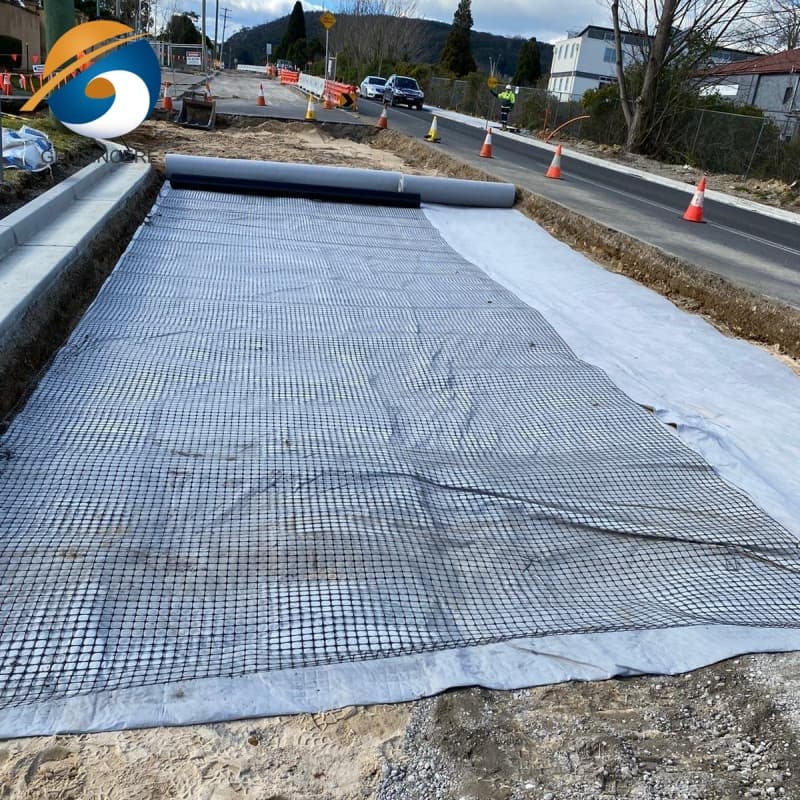
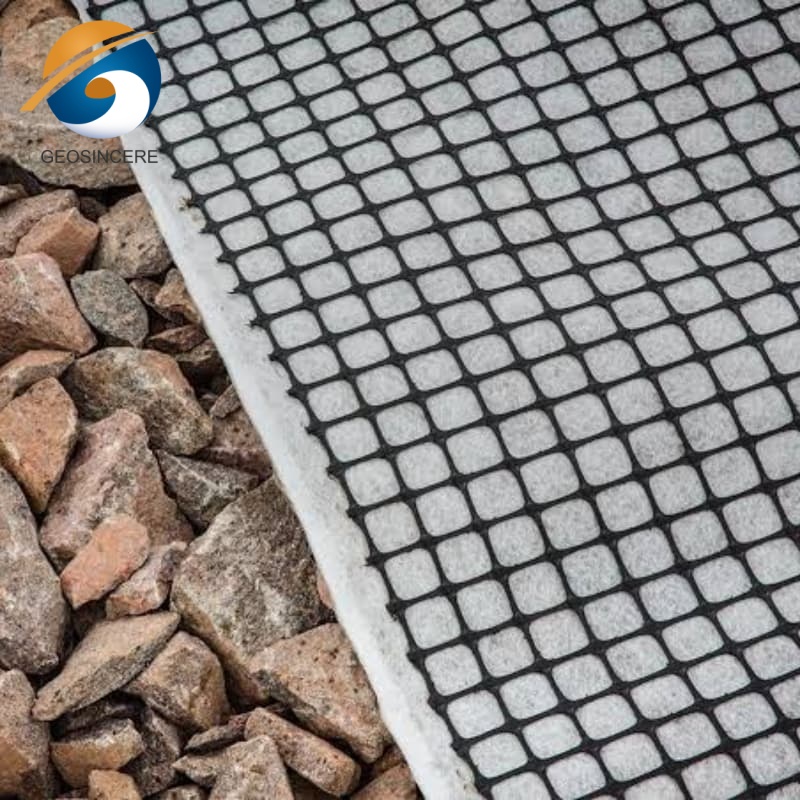
A high-tensile biaxial geogrid heat-bonded to a heavy-duty non-woven geotextile fabric at the factory.
7.2 The Double-Action Advantage:
The bottom fabric layer acts as a flawless separation and filtration barrier (stopping mud from moving up and gravel from moving down), while the top grid layer provides massive structural reinforcement.
7.3 Labor Saver:
Instead of buying, rolling out, and pinning two separate products, your crew rolls out one single product and it's ready for stone. One roll, double the protection.
8. Geogrid for Gravel Cost-Benefit Analysis & ROI
Spend Less Today, Save Massive Tomorrow
Many procurement managers hesitate at the initial cost of geogrids. Let’s look at the actual math for a standard 1,000 sq. ft. driveway:
Expense Factor | Traditional Gravel Driveway (No Grid) | Stabilized Gravel Driveway (With Our Geogrid) |
Required Base Depth | Requires 8–10 inches of deep compacted aggregate to prevent sinking. | Only requires 4–5 inches of aggregate due to structural reinforcement. |
Excavation & Hauling | High labor and trucking fees to dig out and dispose of tons of native soil. | Cuts excavation labor and dump truck trips by 40%–50%. |
Aggregate Material Cost | High. Tons of premium crushed stone needed. | Saves up to 40% on initial aggregate material purchasing bills. |
3-Year Maintenance Cost | Very High. Needs re-grading and fresh gravel top-offs every 12–18 months. | Near Zero. Gravel is locked permanently; no rutting, no shifting. |
The Bottom Line: The geogrid pays for itself on day one just by cutting down your gravel material and trucking costs. The long-term maintenance savings are pure profit.
9. Geogrid for Gravel 3-Step Lightning-Fast Installation
You don't need a specialized crew or expensive rigs to install this system.
9.1 Prep and Roll:
Excavate to your design depth and smooth the subgrade soil. Unroll the geogrid directly onto the ground. (Optional: Use anchoring U-pins to secure the edges in high-wind or sloped areas).
9.2 Dump and Spread:
Backfill the gravel directly onto the geogrid. For the first layer, dump the gravel and push it forward rather than driving heavy trucks directly over the naked grid.
9.3 Compact and Finish:
Level the aggregate and compact it using a standard plate compactor or roller. Your heavy-duty gravel pavement is ready for immediate traffic.
10. Geogrid for Gravel: Packaging, Loading & Logistics for Wholesalers
We understand that ocean freight and warehousing costs directly affect your bottom line. Our rolls are packed with maximum efficiency in mind:
10.1 Compact High-Density Rolls:
Wrapped in heavy-duty UV-stabilized woven bags to protect against transit damage and prolonged outdoor warehouse storage.
10.2 Container Loading Optimization:
Standardized roll lengths (e.g., 50m or 100m) are designed to perfectly match 20GP or 40HQ container dimensions, eliminating wasted dead space and lowering your per-unit shipping cost by up to 15%.
10.3 Easy Forklift Unloading:
Every batch is equipped with durable lifting straps/belts, allowing your warehouse team to safely and rapidly unload containers in minutes without damaging the roll cores.

11. Buyer Trust, Certifications & FAQ
11.1 Global Engineering Compliance:
Our geogrids are manufactured under strict ISO 9001 quality management systems and fully comply with ASTM D6637 (Tensile Properties of Geogrids) and GRI-GG2 standards. Third-party laboratory test reports are provided with every batch.
11.2 Frequently Asked Questions:
Q1: Will extreme weather affect the grid?
A: No. Our material is engineered to withstand extreme temperatures ranging from $-50^\circ\text{C}$ to $60^\circ\text{C}$. It will not crack or become brittle in sub-zero winters, nor will it degrade under high-heat tropical sun.
Q2: Can we order custom roll widths and lengths for large projects?
A: Absolutely. We support full OEM/ODM customization. We can manufacture widths from 1m up to 6m, and custom lengths to minimize on-site cutting waste and seam overlapping.
Q3: Do I need a non-woven geotextile fabric underneath?
A: If you are working on highly saturated, muddy, or fine-clay soils, we highly recommend putting a thin non-woven geotextile fabric down before laying the geogrid. The fabric stops mud filtration, while the geogrid provides structural strength. (We offer composite geogrid-geotextile rolls if you want a 2-in-1 solution).
12. Get a Quote & Free Sample Kit Today
Are you a distributor looking to stock premium geogrids, or a project manager needing a competitive bulk quote for a commercial bid?
- Wholesale & Volume Buyers:
Contact our engineering team for factory-direct pricing, shipping logistics, and custom branding options.
- Free Sample:
Fill out our quick form to receive a complimentary sample kit so you can test our structural stiffness and junction strength firsthand.
Contact Our Shandong Geosino New Material Co., Ltd. (GEOSINCERE Geosynthetics) Geogrid Experts.


