

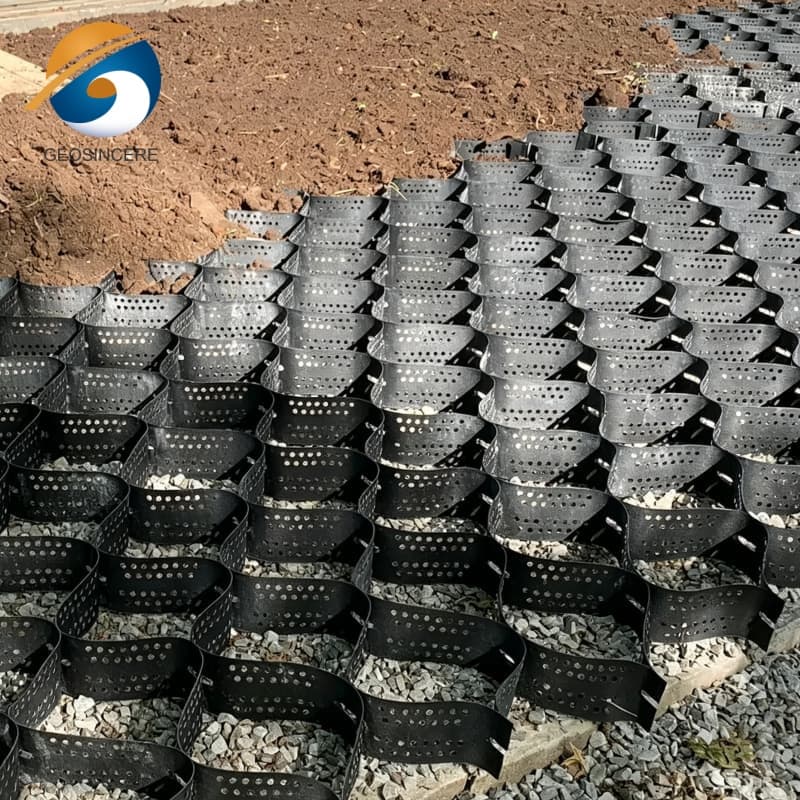
Geocell in Road Construction
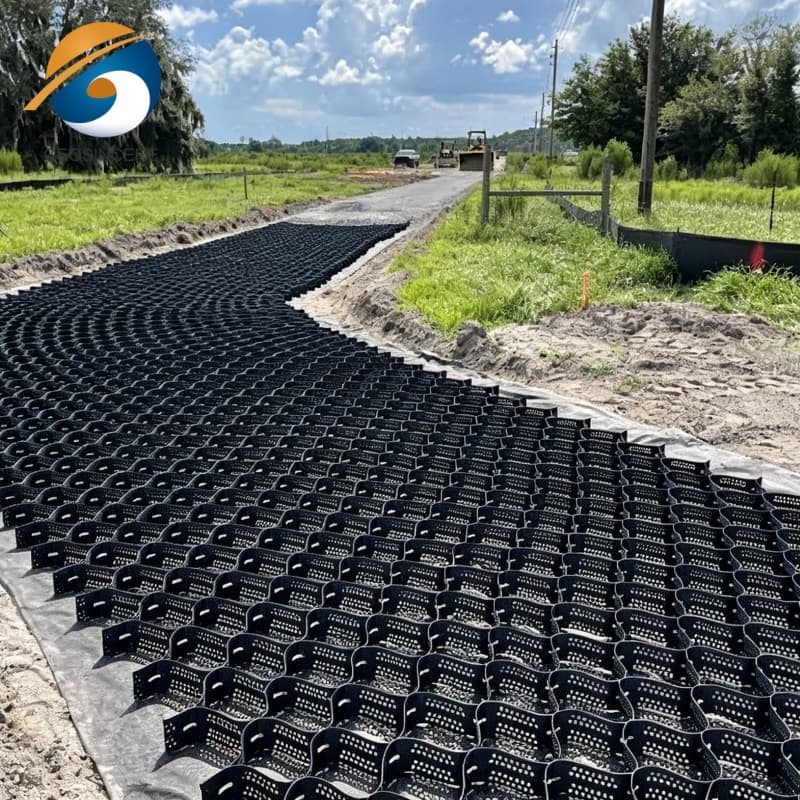
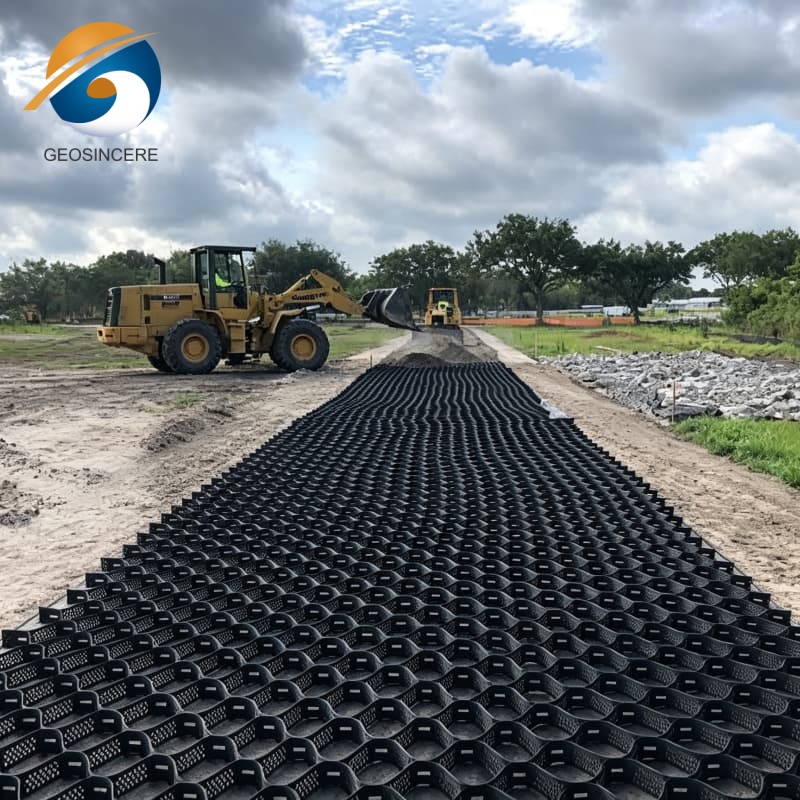
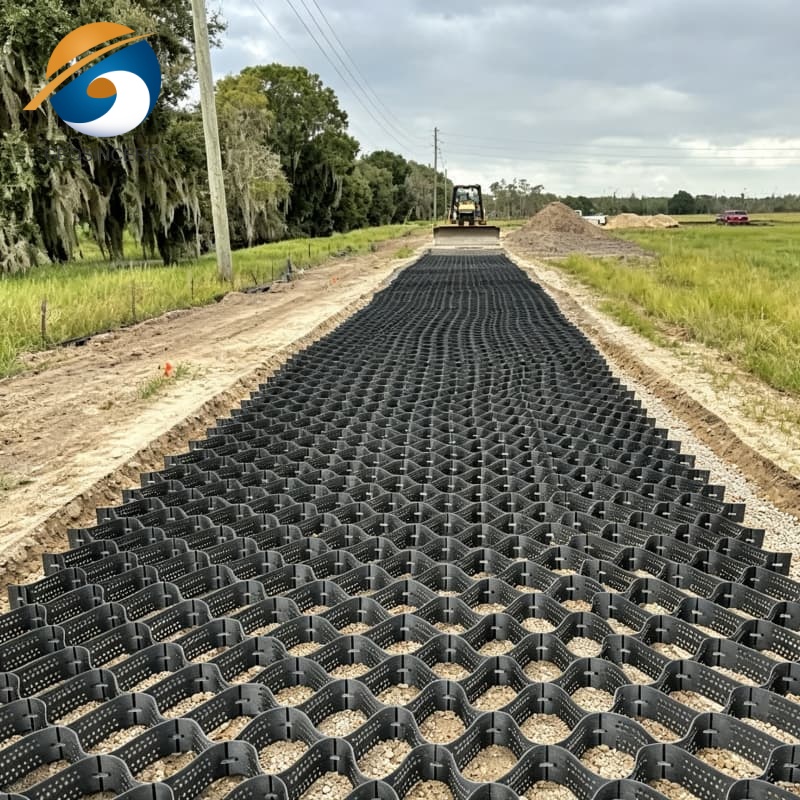
Geocell in Road Construction is a three-dimensional cellular soil stabilization system designed to improve road performance over weak or unstable subgrades. By confining aggregate or soil within interconnected cells, it helps distribute traffic loads, reduce rutting, and improve the stability of road base layers.
- Subgrade Stabilization: Reinforces weak soils and improves load-bearing performance.
- Load Distribution: Spreads vehicle loads across a wider area to reduce subgrade stress.
- Rutting Control: Confinement limits lateral movement of aggregate under repeated traffic.
- Drainage Support: Perforated cells allow lateral water movement through the structure.
- Flexible Infill Options: Compatible with gravel, crushed stone, sand, recycled aggregate, and suitable local soil.
- Wide Road Applications: Suitable for gravel roads, access roads, haul roads, construction roads, and highway base reinforcement.
Engineered for weak subgrades, heavy wheel loads, and severe site environments, our high-density polyethylene (HDPE) geocell forms a rigid-to-flexible 3D cellular confinement mattress that locks non-cohesive infill, stops lateral spreading, and distributes axle stresses across soft, unstable soils
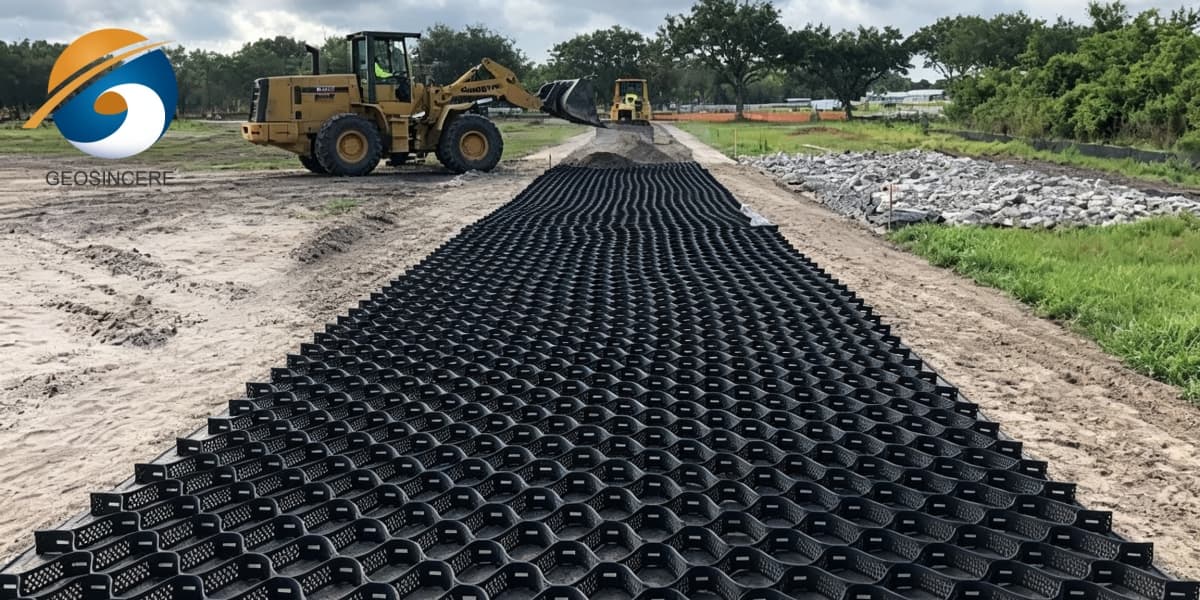
1. What Problem Does Geocell in Road Construction?
Standard road failure stems from a single structural limitation: loose, unbound base/subbase aggregates drift laterally under vertical wheel friction. Over repetitive axial passes, unconfined base layers thin out, leading to subgrade intrusion, deep rutting, differential settlement, and eventual surface shear failure
1.1 Core Road Base Dynamics
1.1.1 3D Lateral Confinement:
Interlocking textured cell walls generate multi-directional hoop stress, locking base course aggregates into a unified structural slab.
1.1.2 Vertical Stress Dispersion:
Spreads high dual-tire contact pressures over a broader footprint, reducing subgrade vertical stress by up to 30–40%.
1.1.3 Differential Settlement Prevention:
Forms a stiff semi-rigid mattress that bridges localized soft pockets, weak spots, and inconsistent subgrades.
1.1.4 Subgrade Intrusion Barrier:
Prevents subbase aggregate from pressing into soft native clay/silt while stopping fines from pumping upward into the base course.
1.2 Structural Performance Comparison
Performance Metric | Unreinforced Base Course | Planar Geogrid / Geotextile | HDPE Geocell System |
Confinement Mechanism | None (pure frictional aggregate interlock) | 2D Planar Tensile Reinforcement | 3D Volumetric Structural Mattress |
Lateral Aggregate Spreading | Severe under dynamic wheel load | Moderate (restricted along 2D plane) | Eliminated via full hoop-stress lock |
Subgrade Load Distribution | Narrow stress cone (high point loads) | Moderate stress cone widening | Wide-footprint beam/slab effect |
Base Aggregate Thickness | Standard design thickness (100%) | 10–20% thickness reduction | 30–50% aggregate reduction |
Use of On-Site Infill Materials | Low (requires high-spec crushed stone) | Moderate (requires graded aggregate) | High (accepts site soils, sand, gravel) |
2. Core Geocell in Road Construction Applications
2.1 Soft Subgrade Road Stabilization
2.1.1 Primary Target Areas:
Silt, saturated clays, peat bogs, high-water-table zones (CBR < 3\%).
2.1.2 Mechanism & Benefits:
Converts soft, unpassable ground into a stable working platform by transforming dynamic wheel point loads into wide-area foundation pressures. The 3D cellular structure provides strong lateral confinement, effectively suppressing soft soil lateral squeezing and subgrade heave. Additionally, it increases the overall subgrade modulus, minimizes long-term differential settlement, and drastically reduces the required thickness of traditional structural aggregate capping layers (often by 30%–50%).
2.2 Unpaved & Rural Access Roads
2.2.1 Primary Target Areas:
Gravel roads, agricultural routes, forestry access tracks, village feeder networks.
2.2.2 Mechanism & Benefits:
Traps aggregate inside 3D cells to prevent lateral displacement caused by heavy farm machinery, high-torque truck tires, and severe monsoon rain erosion. By encapsulating the infill material, the geocell system inhibits washboarding, severe pitting, and gravel loss. This lowers long-term maintenance frequencies, ensures all-weather accessibility for rural communities, and allows the use of cheaper local or lower-grade aggregate infills.
2.3 Heavy Haul & Industrial Passageways
2.3.1 Primary Target Areas:
Mining haul roads, oil & gas rig access tracks, wind farm transport corridors, port logistics yards.
2.3.2 Mechanism & Benefits:
Prevents deep rutting under extreme single-axle loads (>15–30 tons) and maintains subbase integrity under continuous heavy-fleet transit. The rigid 3D confinement interlocking reduces fatigue stresses on lower structural layers, preventing subgrade pumping and progressive structural failure under high-frequency, ultra-heavy wheel impacts.
2.4 Temporary Construction Access Roads
2.4.1 Primary Target Areas:
Contractor staging tracks, temporary bypasses, crane pads, heavy equipment staging sites.
2.4.2 Mechanism & Benefits:
Deploys directly over soft native soil to create an immediate, stable access route using native soil, site-cleared material, or recycled crushed concrete fill. The system substantially speeds up mobilization timelines, avoids full-depth subgrade excavation, and can be retrieved, washed, and redeployed, significantly lowering temporary work expenses and environmental disturbance.
2.5 Road Shoulder Stabilization
2.5.1 Primary Target Areas:
Highway shoulders, unpaved edge drop-offs, runoff zones.
2.5.2 Mechanism & Benefits:
Prevents shoulder erosion, vehicle edge-drop hazards, and lateral pavement breakup caused by off-lane vehicle drift and heavy surface stormwater runoff. By locking shoulder material securely in place, it seals the edge of the main pavement structure, preventing water ingress into the subbase while improving overall roadway safety for emergency stops.

3. Structural Mechanics: How Geocell in Road Construction Enhances Pavement Integrity
Integrating geocell into a road pavement layer introduces three key mechanical reinforcement effects, The Three Structural Pillars:
3.1 Hoop Stress & Hoop Strain Confinement:
Under vertical axle loads, the infill material attempts to spread laterally. The textured HDPE cell walls generate hoop tension, restricting particle movement and increasing the effective modulus (Eeff) of the base layer.
3.2 Beam / Slab Effect:
The interlinked cellular mattress works in tension-compression pairs. Under vertical load, the panel acts as a stiff mattress with flexural resistance, bridging soft subgrade pockets and lowering maximum shear stresses on native soil.
3.3 Passive Resistance & Interface Friction:
Adjacent filled geo geocell exert continuous passive earth pressure on neighboring cells. Ultrasonic wall perforations let aggregate particles interlock across cell walls, increasing inter-panel shear transfer and overall structural stiffness.
4. Geocell in Road Construction Materials, Structural Engineering, and Quality Control
Our geocells are manufactured using virgin High-Density Polyethylene (HDPE) sheets ultrasonically welded into a three-dimensional expandable matrix.
4.1 Physical & Mechanical Properties
Parameter | Specification Standard | Technical Rating |
Base Resin Material | High-Density Polyethylene (HDPE) | 100% Virgin Grade, Non-Recycled |
Carbon Black Content | ASTM D1603 | ≥2.0 % (UV Resistance Grade) |
Environmental Stress Crack Resistance (ESCR) | ASTM D1693 | > 1,000 Hours |
Seam Peel Strength | US Army Corps of Engineers (GL-86-19) | ≥14.2 N/cm per cell height |
Sheet Thickness | ASTM D5199 | 1.1 mm - 1.5 mm (nominal) |
Wall Texture | Rhomboidal Indentations | Coeff. of friction > 0.9 with gravel |
Perforations | Horizontal Elliptical Slots | 11% to 16% surface area open area |
5. Specification Selection Guide for Geocell in Road Construction
Selecting the correct cell height, weld spacing, and wall texture depends on your project's subgrade strength (CBR), wheel axle loads, and infill aggregate size.
5.1 Cell Height Selection Matrix
5.1.1 50mm – 75mm Height:
For light-duty access roads, shoulder stabilization, and high CBR subgrades (CBR > 4%), where reducing base course thickness is the main goal.
5.1.2 100mm – 150mm Height:
The industry standard for medium-to-heavy traffic access roads, gravel roads, and weak subgrades (CBR = 1.5%–3%).
5.1.3 200mm+ Height:
Designed for ultra-soft subgrades (CBR < 1%), heavy industrial and mining haul roads, and extreme axle loads exceeding 20 tons.
5.2 Weld Spacing & Cell Size
5.2.1 Small Cell Size (Weld Spacing 330mm–356mm):
Best for fine-grained infill materials such as sand and fine gravel, as well as applications with high dynamic impact loads requiring dense structural confinement.
5.2.2 Standard Cell Size (Weld Spacing 400mm–445mm):
The primary specification for crushed aggregate, coarse road bases, and standard road construction.
5.2.3 Large Cell Size (Weld Spacing 600mm–711mm):
Recommended for large aggregate fills over 40mm or low-risk, economical subbase applications.
5.3 Wall Surface Configuration
5.3.1 Textured & Perforated (Standard Road Spec):
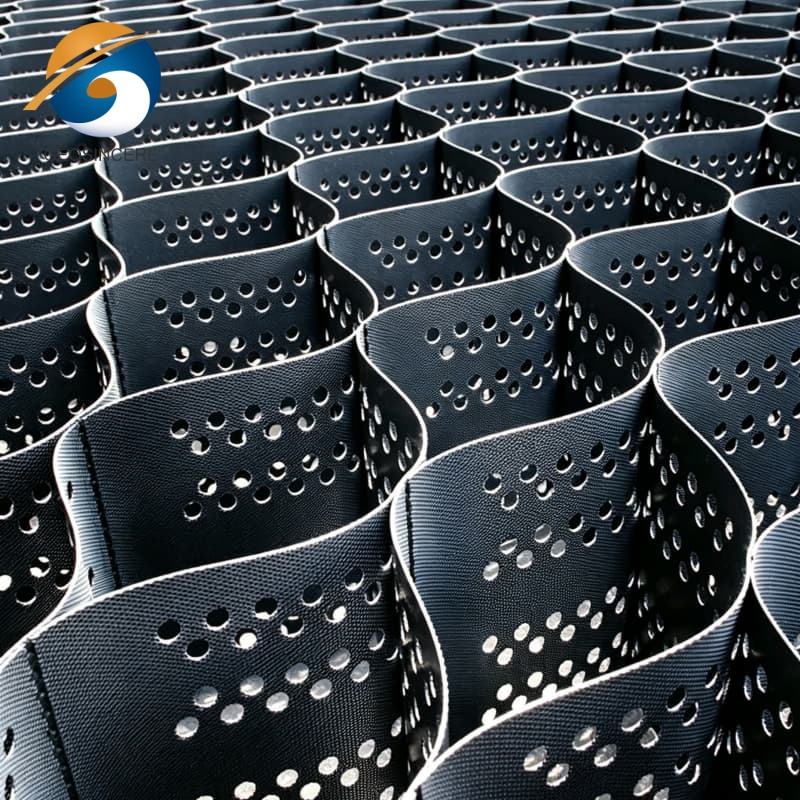
Wall indentations increase aggregate friction, while perforations allow lateral water drainage across cell walls and improve aggregate interlock between adjacent cells.
5.3.2 Smooth & Non-Perforated:
Primarily used for fluid containment, concrete channel lining, and specialized impermeable barrier applications.

6. Geocell in Road Construction Project Selection Quick Matrix
Project Parameters | Recommended Geocell Height | Weld Spacing / Cell Size | Recommended Infill | Key Structural Focus |
Soft Subgrade (CBR < 2%) | 150–200 mm | 356–400 mm | Angular Crushed Stone (20–40 mm) | Subgrade Stress Reduction |
Unpaved Rural Gravel Road | 100–150 mm | 400 mm | Well-Graded Gravel / Recycled Base | Lateral Washout Prevention |
Mining & Heavy Industrial Road | 150–200 mm | 330–356 mm | High-Density Crushed Aggregate | High Axle Shear Resistance |
Temporary Construction Access | 75–100 mm | 400–445 mm | Site Soil / Crushed Concrete | Low Cost & Quick Deployment |
Paved Highway Base Course | 100–150 mm | 356–400 mm | Graded Base Course Aggregate | Base Course Layer Reduction |
7. Structural Economics: Geocell in Road Construction Lifecycle & Cost Reduction Impact
Using HDPE geocells cuts structural road costs by optimizing both up-front construction expenditures (CAPEX) and long-term maintenance cycles (OPEX).
7.1 30%–50% Reduction in Base Course Thickness:
Confinement increases the effective structural load bearing capacity of infill, letting engineers cut base thickness in half without sacrificing structural support.
7.2 Drastic Cut in Trucking & Logistics:
Transporting collapsed geocell panels takes up a fraction of the shipping volume required for bulk aggregate. One truckload of collapsed geocell replaces hundreds of truckloads of crushed rock.
7.3 Lower Maintenance & Longer Pavement Life:
Preventing lateral aggregate drift stops deep rutting, fatigue cracking, and subgrade failure, extending maintenance cycles by 2 to 3 times.
8. Geocell in Road Construction – FAQs
Q1: What materials can be used to fill geocell in road construction?
Typical infill materials include crushed stone, well-graded gravel, sand, recycled aggregate, and suitable site soil. The best material depends on traffic loads, drainage requirements, and subgrade conditions.
Q2: Should geocell be perforated for road applications?
Perforated and textured geocells are commonly preferred for road stabilization because perforations facilitate lateral water movement and textured walls improve interaction with the infill material.
Q3: Can geocell be used on unpaved gravel roads?
Yes. Geocell erosion control is widely applicable to gravel roads, rural access roads, temporary construction roads, and haul roads. It helps limit aggregate spreading, rutting, and lateral displacement under repeated traffic.
Q4: How is geocell installed for road construction?
The typical process includes subgrade preparation, geocell deployment and anchoring, cell expansion, infill placement, compaction, and installation of the next pavement or aggregate layer when required.
Q5: How do I choose the right geocell specification for my road project?
Provide the road dimensions, subgrade CBR, traffic or axle loads, road type, required aggregate thickness, and site conditions. These parameters can be used to determine a suitable geocell height, cell size, and infill configuration.
9. Request an Engineering Consultation & Project Quote
Planning a road construction project over soft subgrades? Looking to optimize your base course thickness and cut aggregate costs? Our technical engineering team is ready to assist with project-specific structural design recommendations and custom manufacturing quotes.
Send Us Your Project Details:
- Total Road Length & Width (m / ft)
- Estimated Subgrade Strength (CBR% or Soil Type)
- Design Traffic Load (Standard Axle Loads / Heavy Haul Fleet)
- Target Infill Material (Local Sand, Crushed Stone, Gravel)
- Required Cell Height & Panel Dimensions (if known)
- Project Location & Estimated Delivery Timeline
Contact our Shandong Geosino New Material Co., Ltd. (GEOSINCERE Geosynthetics) technical sales engineers today to receive a tailored design proposal, product sample kit, and competitive direct-factory quote.


