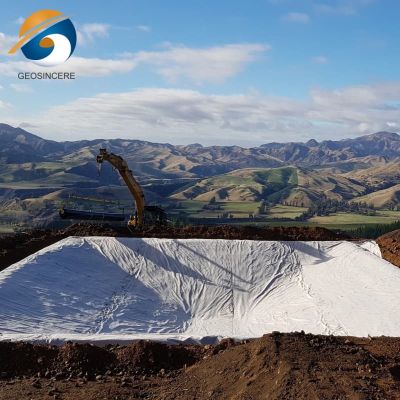
Custom hdpe geomembrane liner
A custom HDPE geomembrane liner is a high-density polyethylene impermeable barrier engineered to project-specific dimensions, thickness, surface texture, and performance requirements. It is widely used in environmental, mining, water containment, and civil engineering projects where standardized liners cannot meet site-specific technical or regulatory demands.
Technical Parameters and Specifications
Custom HDPE geomembrane liners are manufactured to meet international engineering standards while allowing project-level customization:
Material density: ≥0.94 g/cm³
Standard thickness range: 0.5 mm – 3.0 mm
Tensile strength at yield: ≥15 MPa (ASTM D6693)
Elongation at break: ≥700%
Puncture resistance: ≥320 N (ASTM D4833)
Carbon black content: 2.0%–3.0%
Oxidative induction time (OIT): ≥100 min (standard), ≥400 min (high-performance)
Service temperature range: -40°C to +60°C
Structure and Material Composition
The structure of a custom HDPE geomembrane liner is optimized based on mechanical load, chemical exposure, and installation conditions:
Primary Resin: High-density polyethylene (virgin or qualified recycled content)
Carbon Black: UV resistance and long-term durability
Antioxidants: Thermal and oxidative aging protection
Surface Options: Smooth, single-sided textured, double-sided textured
Customization may include embossed textures for slope stability or co-extruded layers for enhanced chemical resistance.
Manufacturing Process and Engineering Control
The production of a custom HDPE geomembrane liner follows a tightly controlled engineering process:
Raw material selection and resin qualification
Precision dosing of carbon black and additives
Flat-die or blown-film extrusion using high-output extruders
Online thickness and surface inspection systems
Controlled cooling to minimize internal stress
Custom roll sizing, panel fabrication, or prefabricated liner systems
Factory quality testing and batch traceability
Manufacturers offering custom HDPE geomembrane liners typically integrate ISO-based quality management and full ASTM or GRI-GM13 compliance testing.
Industry Comparison
| Liner Type | Flexibility | Chemical Resistance | Service Life | Typical Applications |
|---|---|---|---|---|
| HDPE Geomembrane | Moderate | Excellent | 30–50 years | Landfills, mining, wastewater |
| LLDPE Geomembrane | High | Very Good | 25–40 years | Ponds, irregular subgrades |
| PVC Liner | High | Moderate | 15–25 years | Decorative ponds, canals |
| EPDM Rubber | Very High | Good | 20–30 years | Reservoirs, roofing |
Application Scenarios
Custom HDPE geomembrane liners are specified in projects requiring precise engineering adaptation:
Distributors: Supplying region-specific regulatory markets
EPC Contractors: Large-scale civil and environmental projects
Mining Operators: Heap leach pads and tailings dams
Water Authorities: Reservoirs, canals, and wastewater treatment
Industrial Facilities: Secondary containment systems
Core Pain Points and Engineering Solutions
Pain Point 1: Non-standard site geometry
Solution: Prefabricated custom panels to reduce field weldingPain Point 2: UV degradation in exposed applications
Solution: High carbon black content and extended OIT formulationsPain Point 3: Slope instability
Solution: Double-sided textured HDPE geomembrane linersPain Point 4: Long-term chemical exposure
Solution: Resin selection based on chemical compatibility analysis
Risk Warnings and Mitigation Recommendations
Improper specification or installation of custom HDPE geomembrane liners can lead to system failure:
Do not substitute thickness without engineering approval
Avoid unverified recycled content in critical containment
Ensure subgrade preparation meets smoothness requirements
Require certified welding technicians and QA/QC protocols
Procurement and Selection Guide
Define project-specific mechanical and chemical requirements
Select liner thickness based on load and puncture risk
Confirm compliance with ASTM or GRI standards
Request full technical datasheets and test reports
Evaluate manufacturer customization and prefabrication capability
Specify packaging, logistics, and traceability requirements
Engineering Case Scenario
In a mining heap leach project, a custom HDPE geomembrane liner system was supplied with 2.0 mm double-sided textured panels prefabricated to slope geometry. This reduced on-site welding by 35% and improved installation efficiency while meeting chemical resistance and slope stability requirements over multiple operational cycles.
FAQ – Custom HDPE Geomembrane Liner
Q1: What customization options are available?
A: Thickness, texture, panel size, and formulation.Q2: Can liners be prefabricated off-site?
A: Yes, for large or complex geometries.Q3: Is recycled HDPE acceptable?
A: Only if qualified and approved for the application.Q4: What standards apply?
A: ASTM D6693, GRI-GM13, and project specifications.Q5: How long is the service life?
A: Typically 30–50 years under proper conditions.Q6: Can liners be welded in cold climates?
A: Yes, with controlled welding parameters.Q7: Are textured liners harder to install?
A: Slightly, but they improve slope stability.Q8: How is quality verified?
A: Factory testing and field seam testing.Q9: What roll widths are available?
A: Commonly 5–8 meters, customizable.Q10: Are chemical compatibility tests required?
A: Recommended for aggressive media.
CTA – Request Quotation and Technical Documentation
Procurement teams and EPC contractors may request detailed technical documentation, project-specific quotations, or engineering samples for custom HDPE geomembrane liner solutions through professional supply channels.
E-E-A-T Author Credentials
This article is prepared by geosynthetics engineers with extensive experience in HDPE geomembrane manufacturing, international infrastructure projects, and long-term containment system performance evaluation.