Do I Really Need Geotextile Fabric Under Gravel?
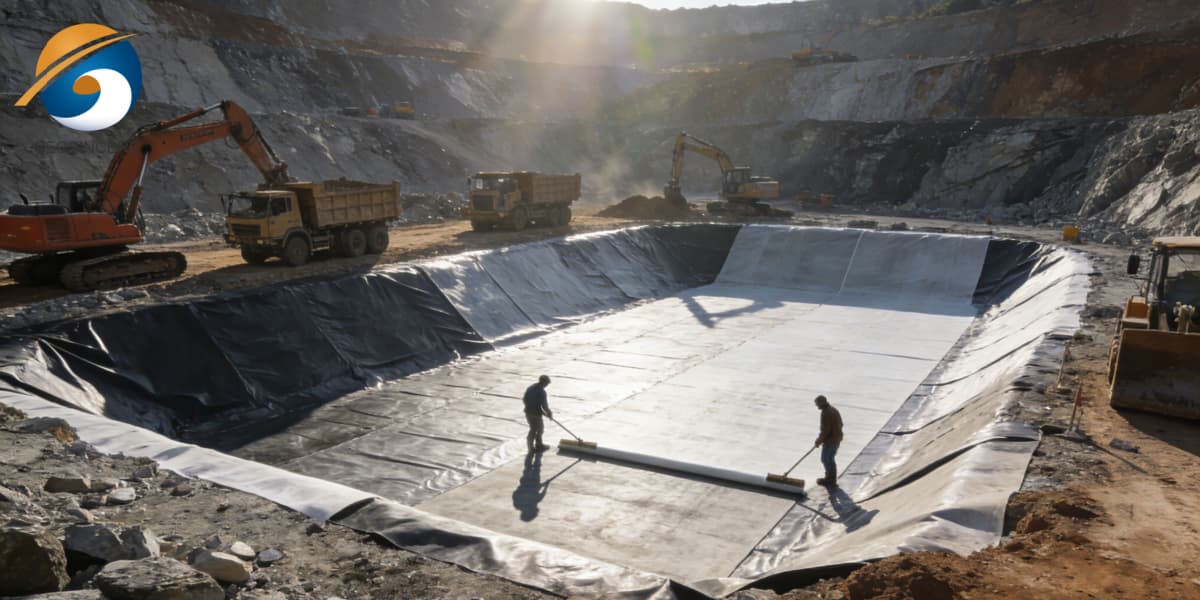
Where construction, civil engineering, and landscaping projects are concerned, one of the greatest assets which the industry has are the components that are hidden, quiet workhorses without which the entire project would collapse. Among these geotextile fabric under gravel—especially when installed underneath gravel—has gained recognition as a groundbreaking feature that has increased the lifespan of a project, made it more cost-effective, and environmentally friendly. This synthetic material, designed for strength, filtration, and separation, will change the mere gravel layer to a high-performance, long-lasting system. Its use under driveways, roads, parking lots, drainage systems, and decorative landscaping is now a standard procedure, but its full benefits are usually undervalued. This article explores the science, applications, and amazing benefits of using geotextile fabric under gravel and it illustrates that the layer is no more just an optional layer but an integral part of sustainable and resilient design.
1. What Geotextile Fabric Under Gravel Is: Far Beyond a Piece of Cloth
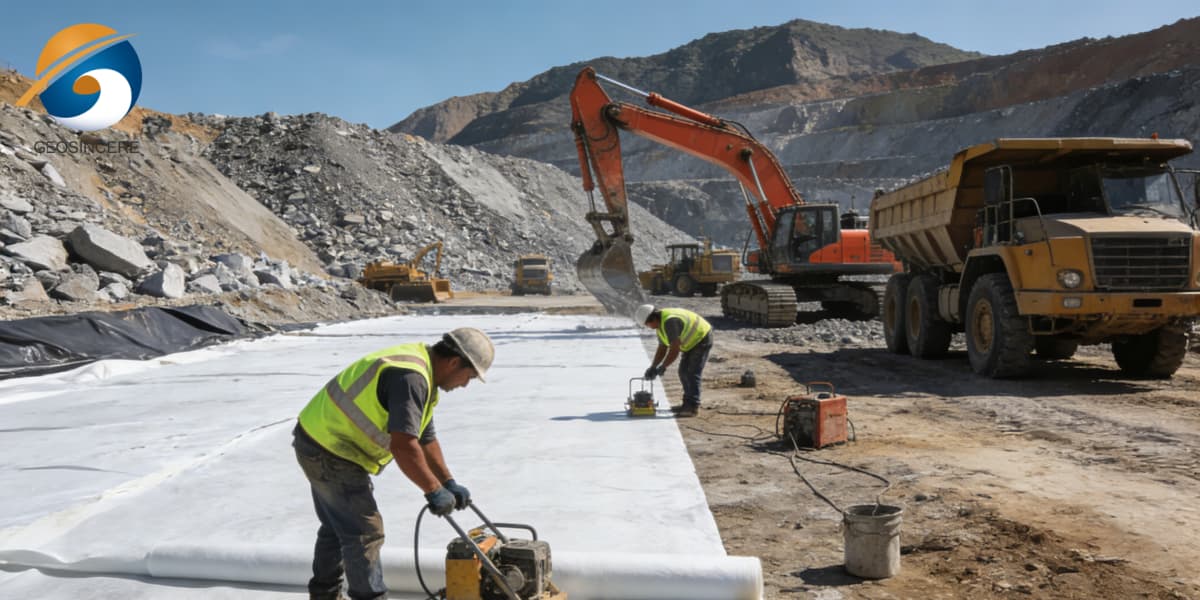
Geotextiles are permeable fabrics composed of synthetic polymers such as polypropylene or polyester. They are manufactured to resist soil, moisture, and mechanical wear. When it comes to laying gravel, only two major types are considered suitable: woven and non-woven. Woven geo fabric under gravel is the result of intertwining single yarns which yield a stretch-resistant fabric. Such fabrics are generally used for road bases and surfaces such as driveways that undergo heavy traffic. Non-woven geotextiles are fabrics that are bonded mechanically, thermally, or chemically, and they have excellent filtration and separation characteristics, so use them for drainage and landscape purposes.
Geo fabric for under driveway is the permeability, separation, filtration, reinforcement, and protective functions of geotextile under gravel that make them invaluable. They let water flow without restriction, yet they stop soil particles from moving. It is this fundamental feature of geotextile-gravel mix that makes it such an efficient solution.
2. Geotextile Fabric Under Gravel Main Working Principle
2.1 Separation and Stabilization
The most important function of geotextile under gravel is to separate different materials. If you were to lay the gravel directly on the subgrade without any treatment, over a period of time the two layers will start to mix. The process gets quicker if you add traffic and water to the equation. The stones will be pushed down into the soft soil while the fine particles of the soil will gradually fill the voids between the stones. This will result in a weakened mixture, which loses its structural integrity as well as its drainage capability; in time, it will become muddy and rutted.
If you place a geotextile fabric between the soil and the gravel, it will act as a permanent separator. The geotextile fabric under gravel driveway will hold the gravel in place and the soil out. This will ensure that the gravel layer maintains its thickness, angularity, and hence its ability to bear loads. The gravel will keep on carrying out the functions for which it was chosen, i.e., providing a stable surface, load distribution, and draining the area. And all these indefinitely! Because of this huge separation, the life of the entire setup is very much extended and thus there will not be any premature breakdowns when costly regrading or regravelling can be avoided.
2.2 Enhancing Drainage and Filtration
In addition to separation, geotextile filter fabric have an essential function in drainage below the surface. It is true that gravel is an excellent medium for drainage but without a filter the empty spaces between stones may get clogged with silt and fines, resulting in blocked drainage paths and hydrostatic pressure buildup. Geo textile material functions like an advanced filter. Its specially designed pore structure facilitates the vertical movement of free water from the soil into the gravel drainage layer, at the same time, it holds the soil particles on the fabric's upstream side. Thus, the filtration is maintaining the gravel available for water passage, thereby the drainage system can continue functioning indefinitely. Geotextile drainage is indispensable for French drains, perimeter drainage, basement footings, and sports fields where water management has to be efficient for safety and use of the structure.
2.3 Load Distribution and Reinforcement
Geotextile filter cloth is often used for ground reinforcement when it comes to unpaved roads, heavy-duty driveways, or parking areas. The fabric's tensile strength makes it possible for the fibers to absorb and distribute the imposed load over a greater area of the subgrade. The geo fabric material slightly stretches when a load is imposed on the gravel surface thus increases its strength and restricts lateral movements of the gravel and soil. Such a "membrane effect" mitigates ruts and other surface deformations especially when the underlying soil is weak and compressible (for instance soft clay or silt). It really turns a bad subgrade into a good working platform and the thickness of an expensive gravel aggregate can be cut down by half in some instances which implies substantial savings in material costs.
3. Geotextile Fabric Under Gravel Applications in Practice
The geotextile-and-gravel combination can be put to use in a variety of ways which is a testament of its versatility:
3.1 Driveways and Access Roads
For driveways in residential areas, tracks on a farm, or construction temporary access roads, a non-woven or woven fabric (depending on load) prevents the formation of ruts and potholes and provides a stable, mud-free surface even in wet conditions.
3.2 Drainage Systems
In the cases of French and curtain drains, a perforated pipe surrounded by gravel is wrapped with nonwoven geotextile fabric. The fabric enables water to enter the drain while filtering soil and thus pipe clogging and system failure are prevented.
3.3 Parking Lots and Unpaved Aisles
This system makes a serviceable, permeable, and low-maintenance surface that is able to withstand vehicle loads for overflow parking, storage of RVs, or industrial yards.
3.4 Landscaping and Pathways
Geotextile fabric under gravel underneath pathways, patios, or rock gardens made of decorative gravel does a double function of suppressing weed growth by preventing sunlight to the soil below, and at the same time, allowing drainage. It makes the landscape neat and well-defined.
3.5 Erosion Control
Non woven filter fabric is utilized on slopes, and gravel check dams or riprap (stones usually bigger) are the ones that are placed on top of them to prevent the soil from being washed away by flowing water. The fabric stabilizes the soil while the gravel dissipates the hydraulic energy.
4. Geotextile Fabric Under Gravel Installation Best Practices
The effectiveness of a geotextile is wholly dependent on correct installation. The process is straightforward but must be followed meticulously:
4.1 Excavate and Prepare
Excavate to the desired depth, ensuring a consistent slope for drainage if needed. Compact the subgrade and remove any sharp debris, roots, or stones that could puncture the geotextile fabric.
4.2 Lay the Fabric
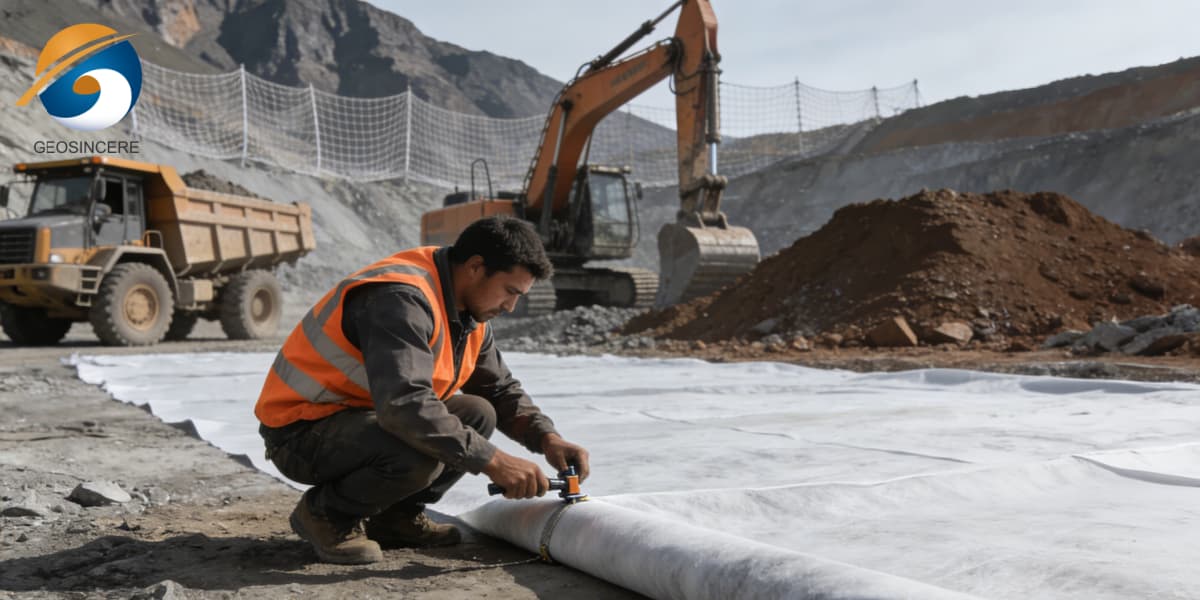
Unroll the geotextile cloth directly on the prepared subgrade. It should be laid flat without tension. Overlap adjacent rolls by a minimum of 12 to 18 inches. On slopes, run the fabric perpendicular to the slope for better stability.
4.3 Secure Temporarily
Use landscape staples or pins to hold the non woven geotextile fabric in place, especially on slopes or windy days.
4.4 Place Gravel
Carefully dump the gravel onto the fabric and spread it using lightweight machinery or tools. Avoid dragging sharp equipment directly on the geo fabric. Maintain a minimum gravel thickness of 4-6 inches for driveways, and 2-3 inches for pathways.
4.5 Compact
Compact the gravel in layers for optimal interlock and stability.
5. Geotextile Fabric Under Gravel Economic and Environmental Benefits
The initial cost of non woven geotextile is minimal compared to the long-term savings it generates. By extending maintenance cycles, reducing aggregate thickness requirements, and preventing catastrophic failures, geotextile fabric for driveway offers an exceptional return on investment. Environmentally, it promotes sustainability. It reduces the need for quarrying and transporting excess aggregate. By improving drainage and reducing runoff and erosion, it protects local waterways from sedimentation. Furthermore, by stabilizing surfaces, it minimizes dust pollution and soil loss.
Conclusion
Geotextile fabric under gravel is a paradigm of intelligent, geosynthetic engineering. It is a simple intervention that solves complex problems of separation, drainage, and stabilization. From safeguarding the foundation of a major highway to ensuring a weed-free garden path, its role is universal. Geofabric is the silent guardian that ensures our built and landscaped environments remain functional, durable, and resilient against the forces of nature and use. As construction and landscaping continue to evolve towards more sustainable and efficient practices, the geotextile fabric will undoubtedly remain an unsung hero, firmly embedded as a best practice standard—literally and figuratively—supporting the world from the ground up. Specifying and installing this critical layer is not an extra step; Geotextile drainage fabric is the defining step between a temporary fix and a permanent solution.
Choose a reliable supplier to quote price for you :
Shandong Geosino New Material Co., Ltd. (GEOSINCERE Geosynthetics) is the professional Geosynthetic clay liners and geosynthetics manufacturer and wholesaler located in Shandong Province, China. We are an professional manufacturer, exporter and wholesaler for such geosynthetic products as HDPE Pool Liner, geotextiles, geogrids, geocells, geosynthetic clay liners (geosynthetic clay linerss), drainage boards, etc.
We have been exporting geotextile and geosynthetics to over 100 countries such as Australia, France, Sweden, UK, Hong Kong, Hungary, New Zealand, Poland, Mexico, Ecuador, Brazil, Pakistan, Bangladesh, Thailand, Vietnam, Malaysia, Indonesia, Singapore, Philippines, Sri Lanka, India, UAE, Saudi Arabia, Qatar, Kenya, Ghana, Ethiopia, Somalia, Nigeria, South Africa, Switzerland, Mongolia, etc. They choose Geosincere as partner for more than 10 years.
GEOSINCERE Geosynthetics has been keeping on investing in technological innovation, manufacturing facilities improvement and turnkey engineering abilities. We have invested 10 million dollars into our manufacturing factory which is equipped with state-of-the-art automatic production lines to manufacture high quality Geosynthetic clay liners and other geosynthetics with optimized processes. Our extensive lines of geosynthetics products are well known for their ensured quality, high performance, excellent durability and best cost effectiveness.
GEOSINCERE Geosynthetics brand geotextile and other geosynthetics products and solutions can meet your requirements by our solid technologies, innovative engineering solutions and excellent customer services. GEOSINCERE Geosynthetics always tries our best to solve the most complex civil, mining and environmental challenges with our innovative and high performance geosynthetic products. Quality assurance, factory price and fast delivery time are our competitive advantages.