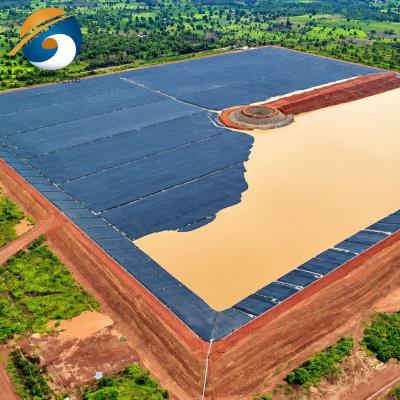
The 7 Best Geomembrane 1mm Options for Farm Dam Liner
Choosing the right liner is one of the most important decisions when constructing or upgrading an agricultural water storage dam. A properly selected geomembrane 1mm can provide an effective barrier against water loss, protect stored water from interaction with surrounding soil, and create a durable lining system when the site is properly designed and installed.
For agricultural reservoirs, irrigation dams, stock-water ponds, and other farm water-storage applications, farm dam liners need to balance impermeability, durability, flexibility, installation requirements, and overall project cost.
A geomembrane 1mm is commonly equivalent to approximately 40 mils. Under the GRI-GM13 specification, 1.0 mm smooth HDPE geomembrane has minimum property requirements including 15 kN/m yield strength, 27 kN/m break strength, 320 N puncture resistance, and 125 N tear resistance.
Below are seven practical geomembrane 1mm options to consider when selecting farm dam liners.

1. The 7 Best Geomembrane 1mm Options for Farm Dam Liner
1.1 1mm Smooth HDPE Geomembrane for Farm Dam Liners
A 1mm smooth HDPE geomembrane is one of the most practical choices for agricultural water storage.
HDPE, or high-density polyethylene, is widely used for impermeable containment because it has very low permeability and good resistance to many chemicals and environmental conditions. A smooth surface also makes the material relatively easy to deploy and heat-weld during installation.
For a farm dam with relatively gentle slopes and a well-prepared subgrade, 1mm smooth HDPE can provide an economical lining solution.
According to GRI-GM13, a 1.00 mm smooth HDPE geomembrane has a nominal thickness of 1.00 mm, minimum average tensile yield strength of 15 kN/m, tensile break strength of 27 kN/m, tear resistance of 125 N, and puncture resistance of 320 N.
For many straightforward agricultural applications, this is the first farm dam liner option worth evaluating.
1.2 1mm Textured HDPE Geomembrane for Sloped Farm Dams
Not every farm dam has a flat or gently sloping profile.
If the side slopes are relatively steep, a 1mm textured HDPE geomembrane can provide better interface friction than a smooth liner. Textured surfaces are designed to improve the interaction between the geo membranes and adjacent soil or geosynthetic layers.
This can be particularly useful when the liner needs to remain stable on inclined surfaces.
However, the correct liner type should be selected according to the actual slope geometry, soil conditions, drainage design, and interface friction requirements rather than simply choosing textured material because it appears stronger.
When should you consider textured geomembrane?
Textured 1mm geomembrane can be considered for:
- Steeper dam side slopes
- Embankment applications
- Sloped agricultural reservoirs
- Areas requiring greater interface friction
- Projects where liner movement is a concern
For horizontal or gently sloping sections, smooth HDPE may remain the more economical choice.
1.3 1mm Virgin HDPE Geomembrane for Long-Term Water Storage
For farm dam liners, material formulation matters just as much as nominal thickness.
A high-quality 1mm hdpe liner should be manufactured from carefully controlled polyethylene resin and formulated with suitable antioxidants and UV stabilizers.
Virgin-resin HDPE geomembrane is particularly attractive when the project requires predictable mechanical and long-term performance.
The GRI-GM13 specification establishes requirements for HDPE geomembranes, including density, tensile properties, tear resistance, puncture resistance, stress-crack resistance, carbon black content, and oxidative induction time.
What should you check?
- Resin information
- Thickness tolerance
- Tensile strength
- Elongation
- Tear resistance
- Puncture resistance
- Carbon black content
- Stress-crack resistance
- OIT results
- Relevant test reports
- Factory quality-control documentation
Two products can both be advertised as “1mm geomembrane” while having different specifications and manufacturing quality.
1.4 1mm HDPE Geomembrane with UV Resistance for Exposed Farm Dam Liners
Why UV resistance matters
Without appropriate stabilization, prolonged exposure to sunlight can gradually affect polymer performance.
For an exposed agricultural reservoir, consider asking the manufacturer for:
- Carbon black content
- Carbon black dispersion
- Oxidative induction time
- UV-aging test information
- Relevant quality certificates
A liner's expected service life depends on much more than thickness alone.
1.5 1mm Geomembrane with Geotextile Protection for Farm Dam
In many farm dam projects, the geomembrane should not be installed directly over rough or rocky ground.
Sharp stones, roots, construction debris, and uneven subgrade conditions can create puncture risks during installation and throughout the service life of the liner.
A protective geotextile layer can be installed beneath the geomembrane to provide cushioning and separation.
This creates a typical system such as:
Prepared Soil → Geotextile → 1mm Geomembrane → Water
Depending on the engineering design, additional protection may also be required above the geomembrane.
1.5.1 Why combine geomembrane with geotextile?
A properly selected geotextile can help:
- Protect the geomembrane
- Reduce puncture risk
- Separate different materials
- Improve the quality of the subgrade interface
- Provide additional protection during installation
The appropriate geotextile weight should be determined based on the subgrade condition, aggregate size, installation method, and expected loading.

1.6 Custom-Fabricated 1mm Geomembrane Farm Dam Liners
For smaller agricultural reservoirs, tanks, channels, or unusual dam geometries, custom fabrication can simplify installation.
Instead of installing every panel individually on site, geomembrane panels can be prefabricated or partially fabricated according to the project's dimensions.
This approach can potentially reduce field welding and installation time.
However, large farm dams generally require careful consideration of:
- Panel dimensions
- Roll width
- Transportation
- Site access
- Field welding
- Anchor trenches
- Penetrations
- Inlet and outlet connections
- Quality control
For larger projects, factory-produced rolls followed by controlled field welding are often more practical.
1.7 Custom-Fabricated 1mm Geomembrane Farm Dam Liners
For smaller agricultural reservoirs, tanks, channels, or unusual dam geometries, custom fabrication can simplify installation.
Instead of installing every panel individually on site, geomembrane panels can be prefabricated or partially fabricated according to the project's dimensions.
This approach can potentially reduce field welding and installation time.
For larger projects, factory-produced rolls followed by controlled field welding are often more practical.
2. How to Choose the Right Geomembrane 1mm for Farm Dam Liners?
Choosing a 1mm geomembrane should not be based on thickness alone.
Before ordering farm dam liners, evaluate the following factors.
2.1 Dam Size
A small agricultural pond and a large irrigation reservoir can have completely different requirements.
Larger dams may require:
- More extensive subgrade preparation
- More welding
- More stringent quality control
- More robust protection systems
- Different thickness or surface configurations
For particularly large or heavily loaded applications, a thicker geomembrane may be more appropriate.
2.2 Side Slope
Slope stability is another important consideration.
A smooth geomembrane can work well on horizontal or gently sloping surfaces, while textured geomembrane may be considered where greater interface friction is needed.
The HDPE geomembrane system should be evaluated together with the underlying soil, protective geotextile, drainage system, and slope geometry.
2.3 Subgrade Condition
The subgrade is one of the most important factors affecting liner performance.
Before installation, the surface should generally be:
- Smooth
- Compacted
- Free from sharp stones
- Free from roots and debris
- Properly graded
- Suitable for geomembrane installation
Even a high-quality 1mm HDPE membrane can be damaged if it is installed over an unsuitable subgrade.
2.4 Water Quality
Consider what the farm dam will store.
The requirements for:
- Irrigation water
- Livestock water
- Process water
- Agricultural wastewater
- Fertilizer-containing water
Where water chemistry or chemical exposure is unusual, confirm material compatibility with the geomembrane manufacturer before selecting the liner.
2.5 Installation Method
The quality of installation can be just as important as the quality of the membrane.
HDPE geomembrana is commonly joined using thermal welding techniques. Field seams should be properly tested and inspected.
A professional installation should consider:
- Welding temperature
- Welding speed
- Surface cleanliness
- Weather conditions
- Seam testing
- Repair procedures
- Final inspection
A high-quality high density polyethylene geomembrane with poor seams will not deliver the expected containment performance.
3. Is Geomembrane 1mm Thick Enough for a Farm Dam?
This is one of the most common questions when choosing farm dam liners.
The answer is: it depends on the project.
A 1mm geomembrana in HDPE can be suitable for certain agricultural water-storage applications, particularly where the subgrade is well prepared, loading is moderate, and the liner system is properly designed.
However, thickness should be selected based on:
- Dam size
- Water depth
- Slope
- Subgrade
- Installation conditions
- Expected mechanical loading
- UV exposure
- Required service life
- Protection system
For projects with rough conditions, heavy construction traffic, steep slopes, or demanding service requirements, 1.5mm or thicker geomembrane may be worth considering.
The key point is that a thicker liner is not automatically the right liner. The complete containment system needs to be engineered for the site.

4. How to Install Geomembrane 1mm Farm Dam Liner?
A successful farm dam liner installation starts before the membrane arrives on site.
Step 1: Prepare the Dam
Excavate and grade the dam according to the engineering design.
Remove:
- Rocks
- Roots
- Sharp objects
- Organic debris
- Loose material
The surface should be compact and smooth enough to support the liner system.
Step 2: Install Protective Geotextile
Where required, install a suitable nonwoven geotextile beneath the geomembrane.
This can provide additional protection against puncture and help create a more uniform interface.
Step 3: Deploy the Geomembrane
Rolls should be positioned carefully to minimize unnecessary movement and avoid wrinkles or damage.
Avoid dragging the geomembrane across rough surfaces.
Step 4: Weld the Seams
Adjacent panels are joined using appropriate thermal welding equipment.
Welding parameters should be controlled according to the material and environmental conditions.
Step 5: Test the Seams
Completed seams should be inspected and tested using appropriate quality-control procedures.
Defects should be repaired before the dam is filled.
Step 6: Secure the Liner
The perimeter of the hdpe geo membrane should be secured according to the project design, commonly using an anchor trench or another engineered anchoring method.
5. Conclusion
For many agricultural water-storage projects, Shandong Geosino New Material Co., Ltd. (GEOSINCERE Geosynthetics) geomembrane 1mm is a practical starting point because it combines impermeability, mechanical performance, weldability, and relatively economical material usage.
The seven options discussed above include smooth HDPE, textured HDPE, virgin-resin HDPE, UV-resistant HDPE, geotextile-protected systems, reinforced/composite systems, and custom-fabricated liners.
The ideal farm dam liners should be selected according to the dam's size, slope, soil conditions, water characteristics, exposure, installation method, and expected service life.
For a standard agricultural reservoir with suitable site conditions, a 1mm smooth HDPE geomembrane manufactured to an established specification such as GRI-GM13, combined with appropriate subgrade preparation and geotextile protection where required, can be a strong option. GRI's specification covers HDPE geomembranes from 0.75 mm through 3.0 mm and establishes thickness-specific mechanical and durability requirements.