

Geo Non Woven Fabric
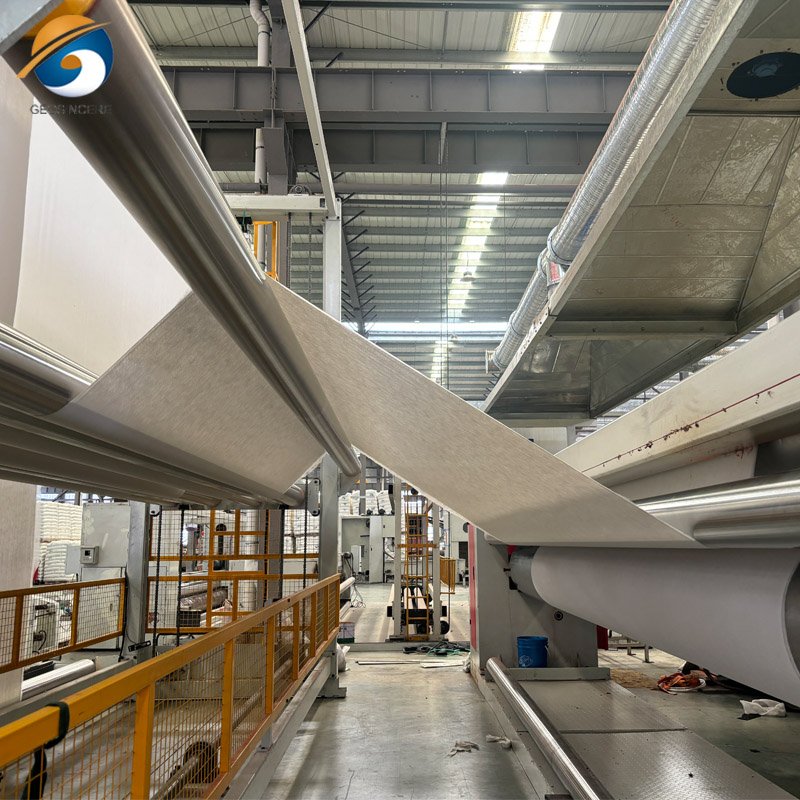
Geo Non Woven Fabric is made from high-quality PP or PET fibers using needle-punching technology. It provides reliable soil separation, filtration, drainage, and protection for various civil engineering and construction projects.
- Soil Separation: Prevents soil and aggregate from mixing.
- Effective Filtration: Allows water to pass while retaining soil particles.
- Reliable Drainage: Supports efficient water flow and reduces clogging.
- High Durability: Offers flexibility and resistance to installation stress.
- Customized Options: Available in various weights, widths, and roll sizes.
- Wide Applications: Ideal for roads, drainage systems, retaining walls, and landscaping.
1. Product Overview
1.1 What is Geo Non Woven Fabric?
Geo Non Woven Fabric is a heavy-duty, permeable synthetic textile engineered specifically for demanding civil engineering, environmental containment, and infrastructure applications. Manufactured from premium, high-tenacity polypropylene (PP) or polyester (PET) staple or continuous fibers, the material is formed through a precision mechanical needle-punching process. During this process, thousands of barbed needles repeatedly punch through the loose fiber web, interlocking the strands into a flexible, three-dimensional porous structure with isotropic mechanical properties.
Unlike woven textiles that rely on a rigid perpendicular grid or standard commercial non-wovens designed for disposable single-use products, Non woven geo fabric features a high internal void ratio combined with high tensile elasticity. This distinct construction enables it to function effectively within complex soil matrixes, under heavy mechanical compaction, and in subgrade environments continuously exposed to groundwater, dynamic wheel loads, and chemical exposure.
1.2 Key Engineering Characteristics & Global Applications
- Three-Dimensional Pore Structure: Provides high fluid permeability while forming a tortuous path that retains fine soil particles.
- Isotropic Mechanical Behavior: Delivers balanced tensile strength, high tear resistance, and exceptional puncture resistance in all stress directions.
- Chemical & Biological Inertness: Resists alkalis, organic acids, biological decay, and soil-borne microorganisms typically found in buried installations.
- Broad Application Spectrum: Widely specified for highway subbases, railway ballasts, subsurface French drains, retaining wall backfills, municipal landfills, tailings containment, and coastal bank protection.
1.2.1 Engineering Reality:
The primary value of non woven geo textile goes beyond simple ground coverage—it establishes a stable, long-lasting interface between disparate soil layers and aggregate strata. By stabilizing subgrades and preserving fluid channels, it mitigates premature structural degradation and extends the functional service life of the entire project.
2. Key Engineering Challenges Addressed by Geo Non Woven Fabric
Subgrade failure, deep rutting, surface cracking, and drainage failure rarely result from structural load miscalculations alone. In most cases, these issues stem from internal soil migration and water management failures taking place beneath the surface.
2.1 Common Subgrade Failure Mechanisms
2.1.1 Soil Intermixing and Structural Contamination
When stone aggregate is placed directly over soft, high-moisture subgrade soil, dynamic traffic loads push the clean aggregate down into the mud while fine subgrade particles migrate upward. This contamination destroys the interlock of the aggregate layer, leading to structural base loss and localized surface settlement.
2.1.2 Drainage Clogging and Piping Erosion
Without a permeable filtration barrier, fine silt and clay particles are carried by groundwater into French drains, trench systems, and perforated pipes. Over time, these fine solids settle inside the aggregate voids, blocking water movement, creating hydrostatic pressure buildup behind walls, and causing slope instability.
2.1.3 Differential Settlement and Surface Rutting
Uneven subgrade strength and variable soil moisture cause localized sinking under heavy axle loads. Without a flexible non woven geotextile to absorb strain and distribute stress evenly across the subbase, rutting quickly propagates upward to the asphalt or concrete surface layer.
2.2 Core Engineering Functions and Solutions
2.2.1 Separation (Preventing Soil Layer Intermixing)
By placing non woven geo textile filter fabric between dissimilar materials (such as subgrade clay and crushed base rock), the geo fabric non woven maintains the structural integrity and design thickness of both layers under both static and dynamic loading.
- Example (Road Construction): Prevents heavy base gravel from sinking into soft subgrade clay under dynamic wheel loads. The gravel base stays clean, maintaining its design compaction, modulus, and load distribution efficiency.
2.2.2 Filtration (Retaining Fines While Maintaining Hydraulic Flow)
The complex 3D pore network allows groundwater to flow freely perpendicular to the fabric plane while retaining fine soil particles on the upstream side, establishing a natural filter zone within the adjacent soil.
- Example (Subsurface Drainage): Wraps perforated collector pipes and gravel trenches in subsurface French drains. It prevents silt and fine sand from entering the drainage pipe, maintaining continuous discharge capacity without clogging.
2.2.3 Drainage (In-Plane Liquid Transmission)
Because needle-punched non-wovens retain significant thickness under compression, they provide continuous in-plane transmissivity, acting as a internal conduit to channel water away from critical engineering zones.
- Example (Retaining Walls & Slopes): Placed directly behind earth-retaining walls or inside steep embankments to relieve hydrostatic pressure buildup, preventing slope sliding, lateral movement, or structural collapse.

3. Geo Non Woven Fabric vs. Standard Woven Fabrics & General Non Wovens
Selecting the correct geotextile requires evaluating structural differences, hydraulic behavior, and mechanical strain capacity under real-world field conditions.
Performance Parameter | Standard Disposable Non-Woven | Standard Woven Geotextile | Geo Non Woven Fabric |
Manufacturing Method | Thermal/Spunbond, low-density | Woven slit-film or monofilament yarns | Heavy-duty needle-punched staple/continuous fibers |
Internal Structure | Thin, two-dimensional sheet | Single-plane grid network | Three-dimensional tortuous fiber matrix |
Filtration Mode | Surface straining; easily blinded | Fixed planar openings; prone to clogging | Deep-bed tortuous path filtration; high clog resistance |
Permeability & Transmissivity | Low to moderate cross-plane flow | Low cross-plane; zero in-plane drainage | High cross-plane flux + continuous in-plane transmissivity |
Elongation & Strain Tolerance | Moderate elongation; low strength | Very low elongation (rigid before rupture) | High strain capacity (50%+ elongation without tearing) |
Puncture & Abrasion Resistance | Poor; easily torn by angular rock | Moderate puncture; sensitive to abrasion | Superior CBR puncture and localized strain resistance |
- Key Procurement Takeaway: While woven geotextiles offer high initial tensile strength at low strain (making them suitable for pure reinforcement), needle punched non woven geotextiles excel in separation, filtration, puncture protection, and drainage applications due to their 3D structure, high elongation, and permeability.
4. Selecting the Right Geo Non Woven Fabric Weight and Specification for Your Project
Matching fabric weight (GSM = Grams per Square Meter) to soil conditions, aggregate angularity, and structural load profiles prevents both material failure and unnecessary expenditure.
4.1 Lightweight Applications (90 gsm – 150 gsm)
Designed primarily for low-stress filtration and light separation where fluid flow is the main requirement and aggregate sizes remain small.
- Typical Projects: Residential landscape beds, planter drainage systems, shallow trench wraps, weed suppression base layers, agricultural subsurface drain lines.
- Engineering Properties: High water flux rates, small opening size (AOS), easy handling, and fast cutting on site.
4.2 Medium-Duty Engineering (200 gsm – 400 gsm)
The industry standard for civil infrastructure, offering a balanced combination of tensile strength, puncture resistance, and hydraulic permeability.
- Typical Projects: Highway subgrade separation, paved and unpaved access roads, gravel driveway stabilization, retaining wall drainage backfills, pipe wrapping in high-water-table areas.
- Engineering Properties: High CBR puncture resistance, capable of handling angular aggregate placement without tearing, excellent long-term soil retention.
4.3 Heavy-Duty Infrastructure (500 gsm – 1000+ gsm)
Heavyweight cushioning layers designed to withstand extreme mechanical loads, severe puncture threats, and aggressive environmental conditions.
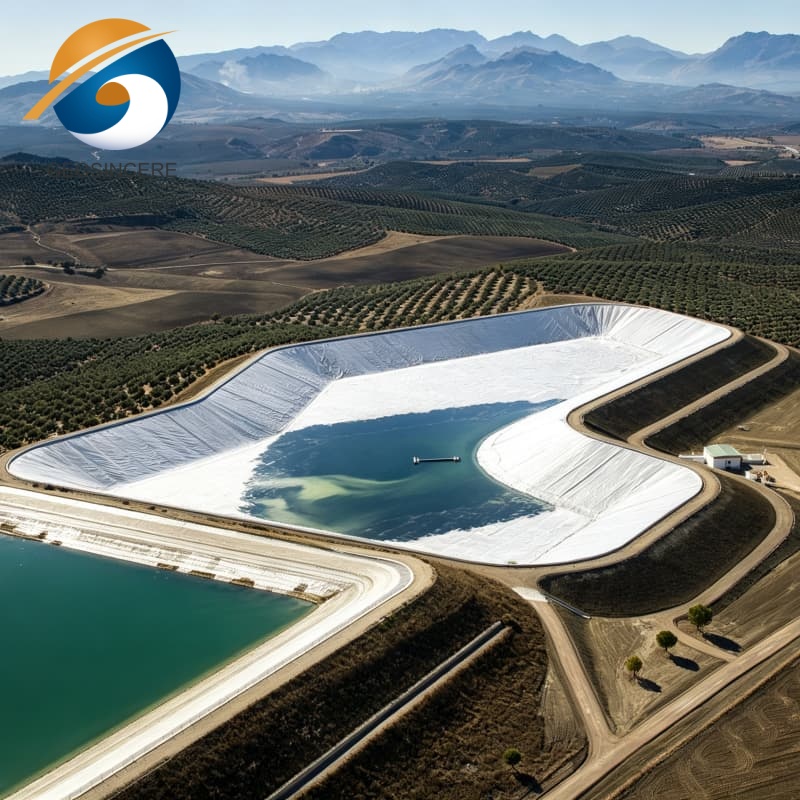
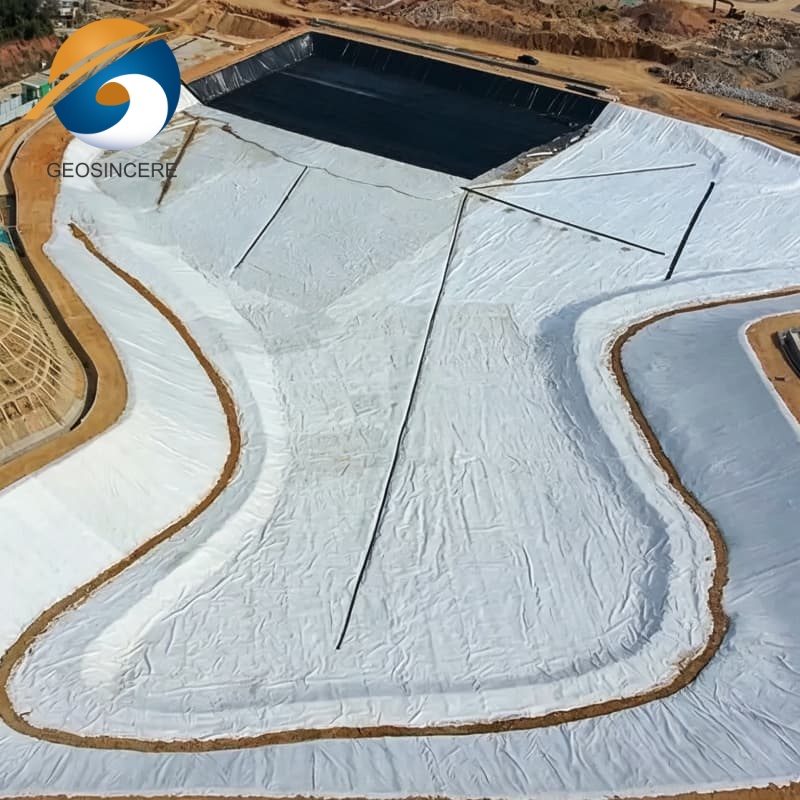
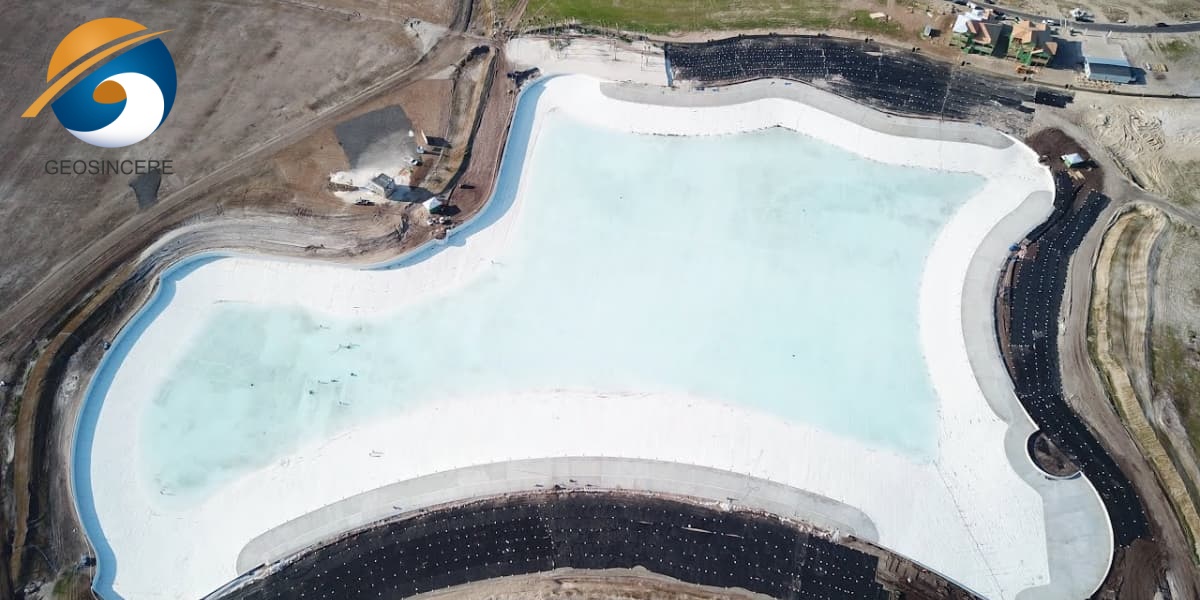
- Typical Projects: Protective cushioning above and below HDPE geomembranes in landfills, hazardous mining tailings ponds, railway ballast reinforcement, coastal rip-rap bank protection, deep tunnel liners.
- Engineering Properties: Exceptional energy absorption, high impact resistance, thick 3D matrix that prevents point-load punctures from sharp subgrade rocks.
5. Core Advantages of GEOSINCERE Geosynthetics Geo Non Woven Fabric
GEOSINCERE Geosynthetics manufactures high-performance geotextile materials designed to meet demanding global engineering specs, ensuring consistency across every roll shipped.
5.1 100% Virgin PP / PET Polymer Resins
GEOSINCERE Geosynthetics uses exclusively 100% virgin Polypropylene (PP) and Polyester (PET) high-tenacity polymers. Virgin polymers ensure consistent tensile behavior, high UV stability, and zero risk of premature structural degradation caused by recycled plastic impurities or regrind contamination.
5.2 Uniform Fiber Distribution & Multi-Directional Strength
Using advanced carding and cross-lapping production machinery, GEOSINCERE Geosynthetics achieves tight, uniform mass distribution across the entire width of the roll. This prevents thin spots, ensuring consistent tensile strength, puncture resistance, and hydraulic flow characteristics from edge to edge.
5.3 Wide Range of Customization Options
- Weight Range: Standard manufacturing spans from 90 gsm up to 1000+ gsm.
- Roll Widths: Customizable from 1.0 meter up to 6.0 meters wide, significantly reducing seam overlap loss and speeding up field installation.
- Roll Lengths: Standard 50m to 200m lengths, or customized to maximize ocean shipping container space.
- OEM & Packaging: Heavy-duty UV-stabilized woven wrapping, custom core tubes, outer protective film, and private label branding.
5.4 Factory-Direct Export & Supply Assurance
Operating multiple dedicated needle-punching production lines, GEOSINCERE Geosynthetics offers stable production scheduling, predictable transit lead times, and factory-direct pricing for large municipal and private project tenders.

6. Geo Non Woven Fabric Typical Project Application Scenarios
6.1 Road and Highway Construction
- The Challenge: Subgrade soft soils mix with base rock under repeated traffic impact, causing base thinning, rutting, and asphalt pavement cracking.
- The Solution: Install GEOSINCERE Geosynthetics fabric geotextile directly over the prepared subgrade before spreading crushed aggregate.
- The Result: Keeps the base rock clean, maintains structural design thickness, distributes wheel loads over a broader area, and increases overall pavement service life.
6.2 Subsurface & French Drainage Systems
- The Challenge: Drainage trenches and wrapped pipes clog as fine sand and silt wash in, stopping groundwater collection and causing waterlogging.
- The Solution: Line the drainage trench with geotextile, fill with clean gravel, wrap the fabric over the top, and backfill with soil.
- The Result: Forms a deep-bed filtration barrier that lets groundwater pass through quickly while retaining fine solids, keeping drainage lines clear over time.
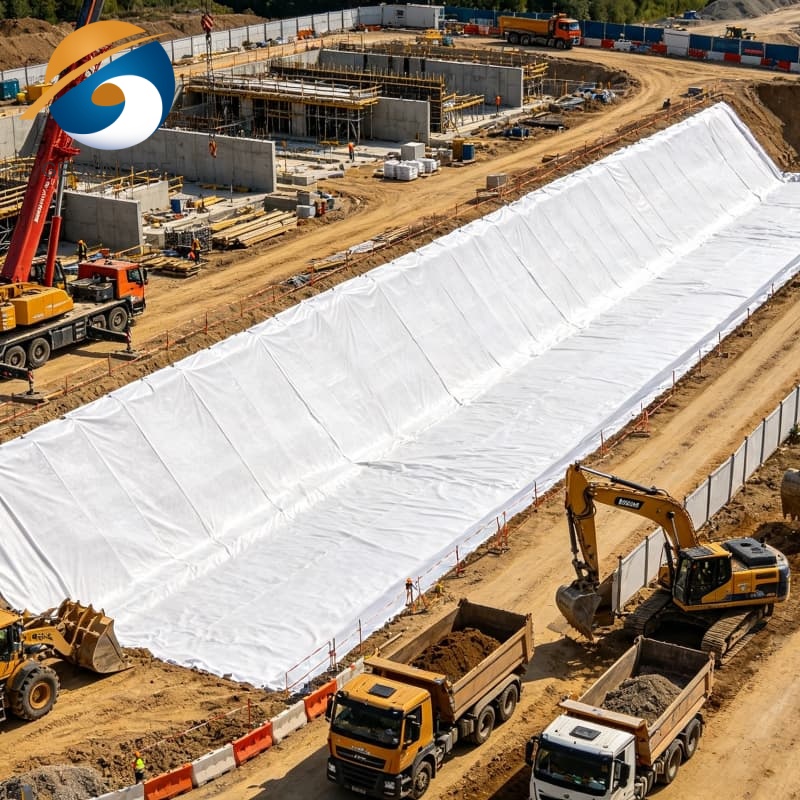
6.3 Retaining Walls & Slope Protection
- The Challenge: Hydrostatic water pressure builds up behind retaining walls, while rainfall causes surface erosion and slope failure.
- The Solution: Install non woven fabric vertically behind retaining wall backfill aggregate, or place it beneath erosion control rip-rap along slopes.
- The Result: Relieves water pressure, prevents soil loss through wall joints, and protects slopes against scour during heavy rainfall.
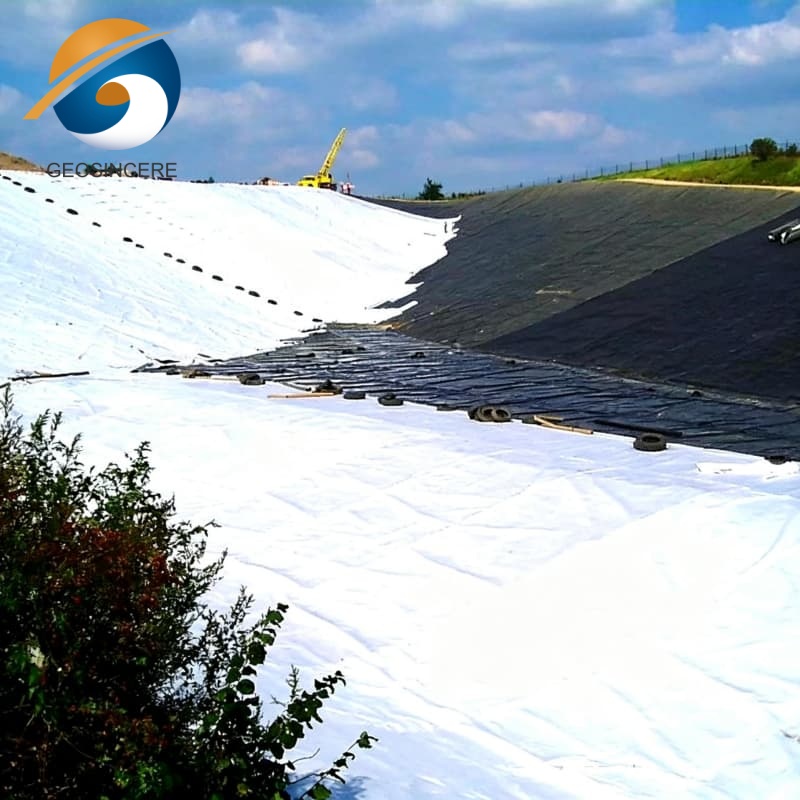
6.4 Landfills & Environmental Protection
- The Challenge: Impermeable HDPE liners can be punctured by sharp subgrade rocks or heavy overlying gravel drainage layers under high load.
- The Solution: Place heavyweight (400–800 gsm) needle punched geotextile directly against the geomembrane liner.
- The Result: Functions as an impact-absorbing cushion, preventing liner punctures and maintaining environmental containment systems.
7. Geo Non Woven Fabric Frequently Asked Questions (FAQ)
Q1: What is the main difference between woven and non woven geotextiles?
Woven geotextiles are made by weaving synthetic yarns into a flat grid, offering high tensile strength at low strain, which makes them well-suited for soil reinforcement. Nonwoven geotextiles are formed through a 3D needle-punching process, yielding high permeability, high strain capacity, deep-bed filtration, and strong puncture resistance. This makes non-wovens better suited for separation, filtration, drainage, and membrane protection.
Q2: How do I choose between Polypropylene (PP) and Polyester (PET) materials?
- Polypropylene (PP) offers high chemical resistance across both acidic and alkaline environments (pH 2–13), making it the preferred choice for landfills, mining leach pads, and high-alkali soil conditions.
- Polyester (PET) provides high tensile modulus, creep resistance, and thermal stability, making it popular for standard highway roadbases, embankments, and general civil works where extreme soil pH is not a concern.
Q3: What fabric weight (GSM) should I use for a gravel driveway or access road?
For standard residential or light commercial gravel driveways over moderate subgrades, a 200 gsm to 300 gsm non-woven geotextile provides an optimal balance of separation, puncture protection, and permeability. For heavy truck traffic, soft subgrade clays, or large rock aggregate, specify a 300 gsm to 400 gsm material.
Q4: What roll width should I select for my construction project?
GEOSINCERE Geosynthetics manufactures roll widths ranging from 1.0m to 6.0m. Using wide rolls (4.0m to 6.0m) reduces the number of side-by-side seams on site, cutting overlap material loss (typically 30cm to 50cm per joint) and speeding up installation over large surface areas.
Q5: How long will Geo Non Woven Fabric last once installed underground?
When buried away from direct UV sunlight exposure, virgin PP and PET geotextiles resist biological decay, soil chemicals, and moisture. They carry a design life of over 50 years in typical underground civil engineering installations.
Q6: Does GEOSINCERE Geosynthetics provide testing samples prior to placing bulk production orders?
Yes, GEOSINCERE Geosynthetics provides physical sample swatches along with certified factory technical data sheets, allowing engineers and procurement teams to inspect material thickness, weight, and mechanical properties prior to placing full orders.
8. Reliable Geo Non Woven Fabric Solutions for Global Infrastructure
Geo Non Woven Fabric is more than a standard construction fabric—it is an engineered protection layer that stabilizes subgrades, preserves fluid movement, and prevents structural breakdown beneath the surface.
Combining customizable specifications, strict quality assurance, and factory-direct supply, Shandong Geosino New Material Co., Ltd. (GEOSINCERE Geosynthetics) provides dependable geo non woven fabric products tailored to highways, French drains, environmental containment liners, and infrastructure projects worldwide.


