

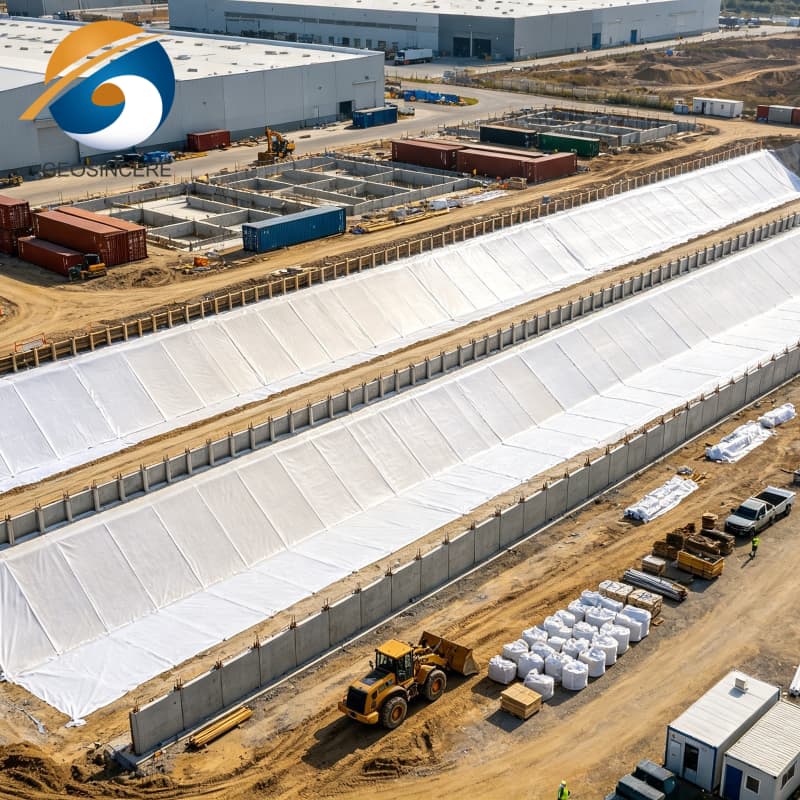
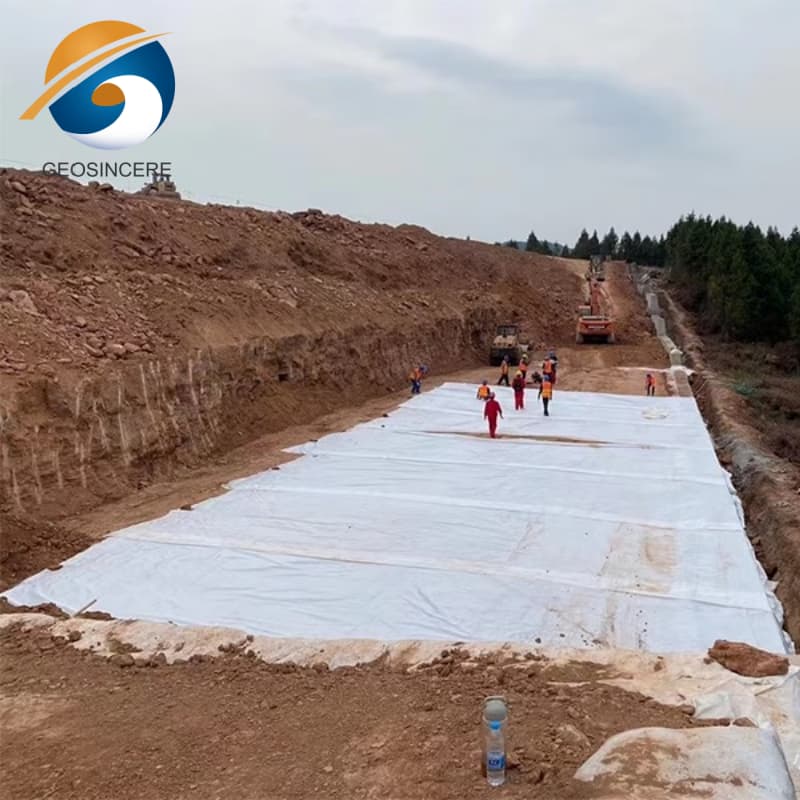
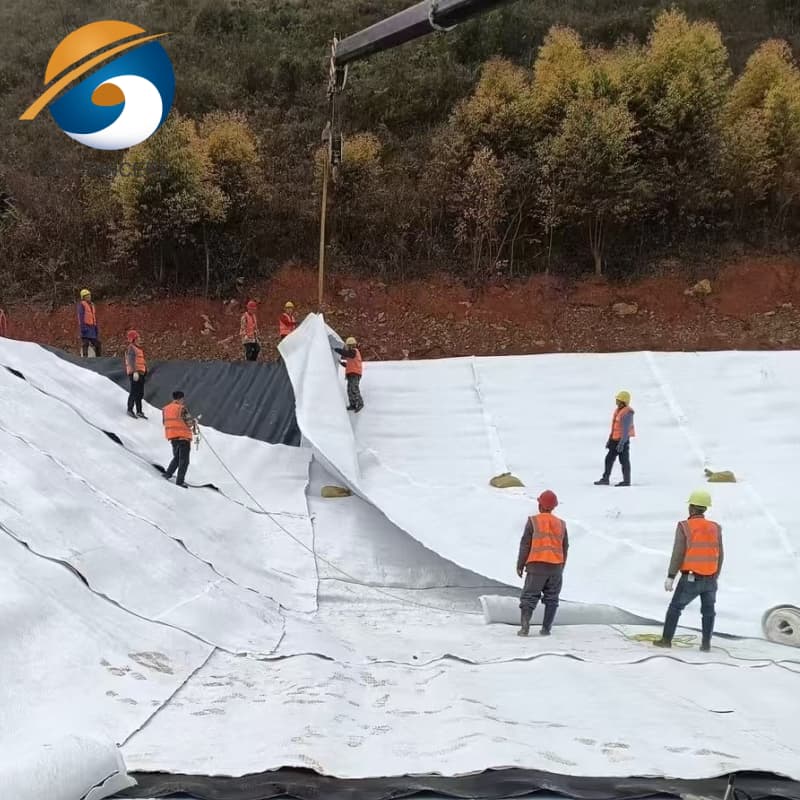
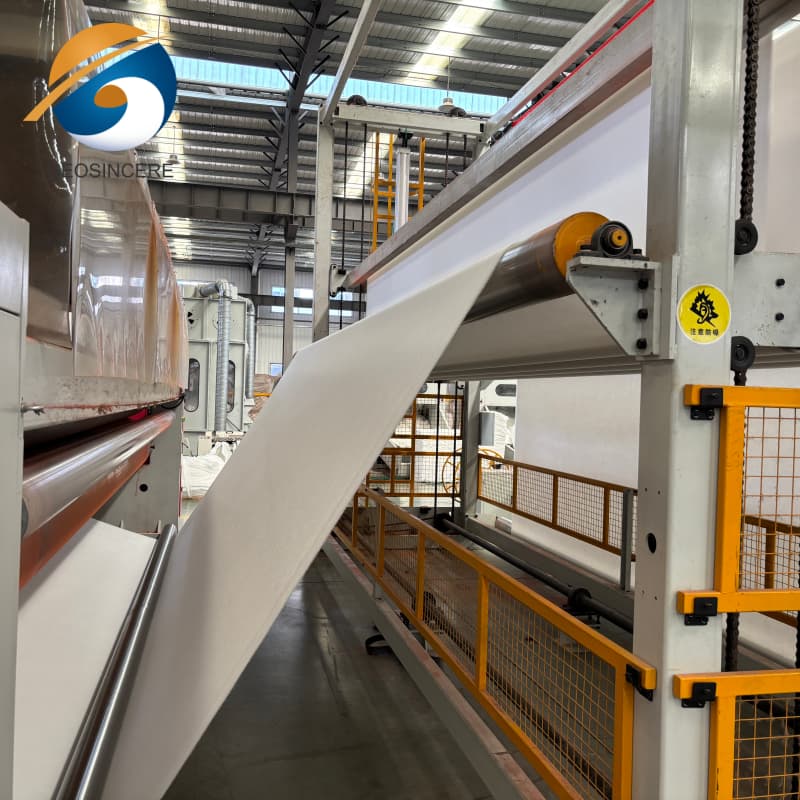
Geotextile for Retaining Wall
Our geotextile is an essential filtration and drainage layer designed to protect retaining walls from water damage. Made from 100% virgin polypropylene, geotextile for retaining wall lets water drain freely while permanently trapping fine soil particles to ensure maximum wall stability.
- High-Flow Drainage: Quickly relieves water pressure behind walls to prevent bulging and collapse.
- Clog-Proof Filtration: Traps fine silt while keeping drainage stone clean and free-flowing.
- Tough & Tear-Resistant: Handles heavy crushed rock and high soil pressure without puncturing.
- 50+ Year Durability: Resistant to soil chemicals, rot, mold, and long-term soil acids.
- Saves Money: Prevents expensive soil-gravel mixing and cuts long-term maintenance costs.
Over 90% of retaining wall failures are not caused by structural block defects—they are caused by trapped water and uncontrolled soil migration. When rainwater saturates the backfill zone, hydrostatic pressure builds rapidly, leading to wall bulging, joint displacement, and costly structural collapse.
Our geotextile fabric is engineered specifically to eliminate back-of-wall water pressure while permanently separating drainage aggregate from native subgrade soil. Manufactured from 100% continuous-filament polypropylene using high-density needle-punch technology, this geotextile for retaining wall acts as an active, clog-proof filter layer. It allows high-volume water flow directly into your drainage system while keeping fine clay, silt, and soil particles firmly in place—ensuring your retaining wall remains square, stable, and maintenance-free for decades.

1. Problem & Solution: Why Traditional Walls Fail
Up to 90% of retaining wall failures are caused by hydrostatic pressure build-up from trapped water. When fine clay or topsoil mixes with drainage aggregate, the drain pipe clogs, water pools behind the wall, and the structure bulges, leans, or collapses.
Our geotextile for retaining wall solves this issue permanently by acting as an engineered filter and separation layer:
1.1 Keeps Aggregate Clean:
Prevents fine native soil particles from washing into and clogging your crushed stone drainage zone.
1.2 Relieves Hydraulic Pressure:
Allows high volumes of water to pass through into perforated drain pipes without impedance.
1.3 Extends Structural Lifetime:
Prevents soil piping, foundation settling, and wall face staining.
2. Geotextile for Retaining Wall Differential Advantages
2.1 3D Needle-Punched Structure:
Unlike standard woven fabrics that blind/clog easily, our randomly oriented 3D fiber matrix maintains open flow channels under extreme soil compression.
2.2 100% Virgin Polypropylene (PP):
Made from 100% pure PP with zero recycled fillers. Highly resistant to soil acids, alkalis, road salts, biological rot, and long-term chemical degradation.
2.3 Engineered Puncture Resistance:
High CBR puncture strength allows contractor crews to dump sharp aggregate (e.g., angular crushed granite) directly onto the geotextile fabric for retaining walls without tearing.
2.4 Superior UV Stabilization:
Formulated with carbon black additives to withstand up to 500 hours of direct sunlight exposure during active job-site installation without weakening.
2.5 Consistent Quality Control:
Every roll is tested for grab tensile strength, Mullen burst, and permittivity to meet ASTM civil engineering standards.

3. Geotextile for Retaining Wall Product Application Scenarios
Our non woven geotextile fabric is designed for versatile performance across heavy-duty civil engineering and residential landscaping projects. Below are the primary application scenarios:
3.1 Segmental Retaining Walls (SRW) & Gravity Walls
3.1.1 Application:
Line the back of concrete modular blocks, timber retaining structures, and poured concrete walls before backfilling with crushed stone aggregate.
3.1.2 Why It’s Needed:
Water buildup behind walls creates immense hydrostatic pressure. This fabric forms a dedicated drainage column behind the wall units, allowing trapped groundwater to exit quickly through weep holes or drain pipes without bringing mud along with it.
3.1.3 Key Benefit:
Prevents wall bulging, block tilting, and structural collapse while eliminating face staining caused by mud seepage.
3.2 French Drains & Subsurface Drainage Trenches
3.2.1 Application:
Wrap around perforated drain pipes (corrugated or PVC) and line the surrounding gravel trench ("envelope installation").
3.2.2 Why It’s Needed:
Fine clay and silt particles naturally wash into subsurface trenches during heavy rainfall, quickly clogging the perforated holes in the pipe and filling the void spaces in surrounding gravel.
3.2.3 Key Benefit:
Provides high-flow filtration that keeps the drainage gravel clean and free-flowing, ensuring 100% drainage capacity for decades without requiring pipe flushing or costly trench re-excavation.
3.3 Driveways, Roadways & Paver Subgrade Stabilization
3.3.1 Application:
Lay directly over native subgrade soil before dumping base rock for asphalt roads, gravel driveways, paver patios, and parking lots.
3.3.2 Why It’s Needed:
Vehicles driving over unreinforced surfaces force soft soil up into the gravel base while pushing aggregate downward. This mixing causes rutting, potholes, and surface sinking.
3.3.3 Key Benefit:
Permanently separates soft subsoil from clean aggregate base layers, increasing load-bearing capacity by up to 40% and cutting future gravel replenishment costs significantly.
3.4 Erosion Control, Slopes & Shoreline Rip-Rap Protection
3.4.1 Application:
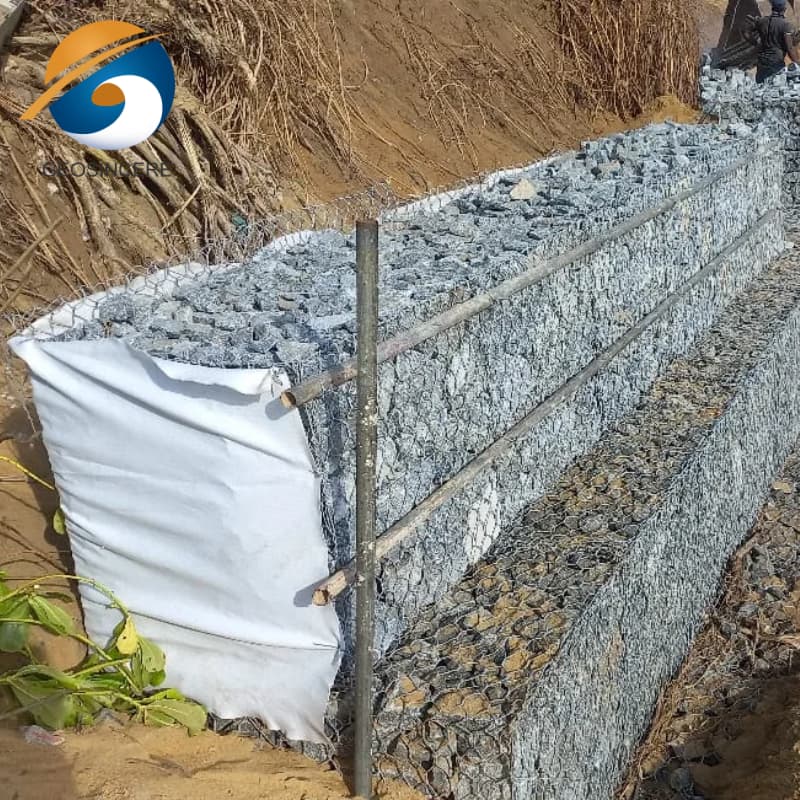
Place beneath heavy stone rip-rap, gabion baskets, and revetment mats along lakefronts, riverbanks, storm basins, and steep embankments.
3.4.2 Why It’s Needed:
Wave action, stream currents, and severe runoff wash fine soil out from underneath heavy armoring rocks, undermining the bank and causing sudden cave-ins.
3.4.3 Key Benefit:
Holds underlying soil matrix firmly in place while allowing groundwater to bleed out safely, preventing slope failure under high-velocity water conditions.
3.5 Green Roofs, Planter Boxes & Urban Landscaping
3.5.1 Application:
Install as a filtration liner between lightweight growth media (soil) and drainage core plates or aggregate in rooftop gardens and large commercial planters.
3.5.2 Why It’s Needed:
Soil washing down into the drainage layer can block drain outlets on elevated structures, risking water pooling, structural overloading, and root rot.
3.5.3 Key Benefit:
Keeps soil particles contained within the planting zone while maintaining instant vertical drainage out of the container or green roof system.

4. Geotextile for Retaining Wall Technical Specifications & Material Selection Guide
Property | Standard / Test Method | 4 oz / yd² (135 gsm) | 6 oz / yd² (200 gsm) | 8 oz / yd² (270 gsm) |
Material Composition | - | 100% Virgin Polypropylene Needle-Punched Non-Woven | 100% Virgin Polypropylene Needle-Punched Non-Woven | 100% Virgin Polypropylene Needle-Punched Non-Woven |
Grab Tensile Strength | ASTM D4632 | 115 lbs (0.51 kN) | 160 lbs (0.71 kN) | 220 lbs (0.98 kN) |
Elongation at Break | ASTM D4632 | 50% | 50% | 50% |
CBR Puncture Resistance | ASTM D6241 | 310 lbs (1.37 kN) | 435 lbs (1.93 kN) | 600 lbs (2.67 kN) |
Water Flow Rate | ASTM D4491 | 140 gal/min/ft² | 110 gal/min/ft² | 90 gal/min/ft² |
Apparent Opening Size (AOS) | ASTM D4751 | 70 U.S. Sieve (0.212 mm) | 80 U.S. Sieve (0.180 mm) | 80 U.S. Sieve (0.180 mm) |
UV Resistance (500 hrs) | ASTM D4355 | ≥ 70% Strength Retained | ≥ 70% Strength Retained | ≥ 70% Strength Retained |
4.1 Weight Recommendation Matrix (For Buyers)
4.1.1 4 oz / yd² (Light Weight):
Ideal for low-height landscape walls (<3 ft), light French drains, planter lining, and residential garden projects.
4.1.2 6 oz / yd² (Medium Weight - Best Seller):
Standard for commercial & residential retaining walls (3 ft–8 ft), driveway underlayments, and high-flow subsurface drainage.
4.1.3 8 oz / yd² (Heavy Duty):
Specified for heavy civil engineered walls (>8 ft), bridge abutments, highway sub-bases, and high-impact rip-rap stabilization.
5. Geotextile for Retaining Wall Step-by-Step Installation Guide
5.1 Excavation & Subgrade Prep:
Excavate the wall base and backfill zone. Remove sharp debris, roots, and large jagged rocks.
5.2 Fabric Placement:
Unroll the geo fabric retaining wall along the length of the excavation trench, lining the back of the wall and wrapping down into the drainage trench.
5.3 Overlapping Seams:
Ensure all adjacent roll edges overlap by a minimum of 12 to 18 inches (30 to 45 cm) to prevent soil migration at joints.
5.4 Pipe & Stone Backfill:
Place the perforated drain pipe in the trench over the fabric, then fill the drainage zone with clean crushed stone (e.g., 3/4" clear aggregate).
5.5 Enclose & Backfill:
Fold the remaining geo fabric for retaining walls overlap back over the top of the crushed stone layer ("envelope technique") before backfilling with native soil. Compact in 6 to 8-inch lifts.
6. Geotextile for Retaining Wall Financial & Practical Benefits for Buyers & Contractors
6.1 Reduced Maintenance Costs:
Eliminates costly wall rebuilds and pipe jetting caused by mud-clogged drainage systems.
6.2 Aggregate Cost Savings:
Prevents clean crushed rock from sinking into soft clay subgrades, reducing total aggregate volume required by up to 25%–30%.
6.3 Labor Efficiency:
Lightweight, flexible rolls are easy for crew members to transport, cut with standard utility knives, and lay out quickly.
6.4 Long Service Life:
Evaluated for a 50+ year design life in typical soil conditions, protecting contractor warranties and project reputations.
7. Geotextile for Retaining Wall Frequently Asked Questions (FAQ)
Q1: Should I choose Woven or Non Woven geotextile for a retaining wall?
A: Always choose non woven geotextile for retaining wall backfill and drainage. Woven fabrics are strong but have low water permeability and easily blind/clog when exposed to fine silts and clays. Non-woven fabric acts as an active filter that allows water to pass through while trapping fine particles.
Q2: Can this fabric be installed in frozen or wet ground?
A: Yes. Polypropylene geotextiles do not absorb moisture (hydrophobic) and maintain structural strength across freezing and thawing cycles.
Q3: Does this fabric stop tree roots?
A: While it acts as a mechanical separator, non woven fabric geotextile is permeable and not a chemical root barrier. For severe tree root pressure, a specialized HDPE root barrier should be used alongside the drainage fabric.

Partner with GEOSINCERE Geosynthetics: Build Walls That Stand the Test of Time
When it comes to retaining wall durability, the hidden components matter most. Shandong Geosino New Material Co., Ltd. (GEOSINCERE Geosynthetics) delivers premium, civil-grade geotextile solutions backed by strict ISO quality management, advanced production technology, and fast worldwide shipping. Whether you are a distributor looking for customizable OEM roll sizes or a contractor sourcing reliable materials for large-scale infrastructure projects, GEOSINCERE Geosynthetics is your trusted global partner for high-performance geosynthetics.
Ready to secure your next project?
Contact the GEOSINCERE Geosynthetics engineering team today to request free product samples, technical datasheets, or a competitive factory-direct quote!


