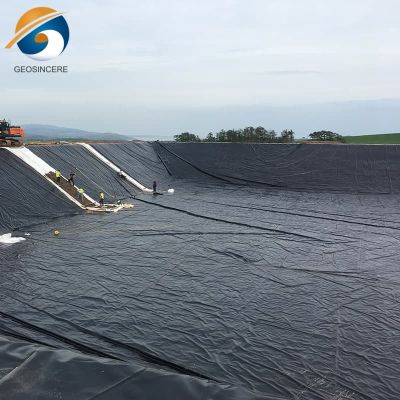
1.0mm vs 1.5mm geomembrane cost difference
HDPE geomembranes are engineered polyethylene sheets used for containment, waterproofing, and environmental protection. The 1.0mm variant offers cost efficiency and ease of installation, while the 1.5mm version provides enhanced mechanical strength and long-term durability for demanding projects.
Technical Parameters and Specifications
| Parameter | 1.0mm HDPE | 1.5mm HDPE | Unit |
|---|---|---|---|
| Thickness | 1.0 | 1.5 | mm |
| Tensile Strength | 20–25 | 25–30 | MPa |
| Elongation at Break | 600–700% | 650–750% | % |
| Puncture Resistance | 250–350 | 400–500 | N |
| UV Resistance | High | High | – |
| Service Life | 10–15 | 15–20+ | Years |
Structure and Material Composition
Base Resin: High-density polyethylene (HDPE) providing chemical resistance and mechanical strength.
UV Stabilizers: Carbon black and antioxidants for extended outdoor service life.
Optional Additives: Anti-blocking agents, slip-enhancers, or textured embossing for specific applications.
Manufacturing Process
Step-by-Step Process
Polyethylene resin blended with additives and UV stabilizers.
Extrusion through flat-die or blown-film extrusion systems.
Thickness controlled precisely for 1.0mm or 1.5mm variants.
Cooling and surface inspection for uniformity.
Rolling into standard widths and lengths; labeling for shipment.
Quality assurance including tensile, puncture, and thickness verification.
Industry Comparison
| Criteria | 1.0mm Geomembrane | 1.5mm Geomembrane | Recommended Usage |
|---|---|---|---|
| Cost per m² | Lower | Higher | Budget-sensitive projects |
| Mechanical Strength | Moderate | High | Heavy load, landfill, or steep slope projects |
| Installation Ease | High | Moderate | Flat surfaces or limited labor skill |
| Durability | 10–15 Years | 15–20+ Years | Long-term environmental containment |
| Puncture Resistance | 250–350 N | 400–500 N | High-risk subgrade areas |
Application Scenarios
1.0mm: Wastewater ponds, reservoirs with low mechanical load, temporary containment, EPC projects requiring fast deployment.
1.5mm: Landfills, tailings dams, steep slope reservoirs, chemical storage ponds.
Used by civil contractors, EPC firms, and industrial project engineers.
Preferred by distributors and importers handling large-scale projects.
Core Pain Points and Solutions
1. Budget Constraints
Solution: Choose 1.0mm geomembrane for cost-sensitive or temporary projects.
2. Mechanical Damage Risk
Solution: Deploy 1.5mm geomembrane where puncture or abrasion risk is high.
3. Installation Speed
Solution: 1.0mm thickness allows faster handling and welding.
4. Long-Term Durability
Solution: 1.5mm ensures service life exceeding 15–20 years, suitable for permanent structures.
Risk Warnings and Mitigation
Thin liners may be prone to punctures on uneven subgrades.
Incorrect welding can compromise containment; follow strict QA/QC procedures.
Improper storage can expose geomembranes to UV degradation before installation.
Sloped surfaces require adequate anchoring and potential textured variants.
Procurement and Selection Guide
Determine project requirements: slope, load, chemical exposure.
Assess environmental conditions (UV, temperature, chemical contact).
Define desired service life and durability needs.
Compare lifecycle cost of 1.0mm vs 1.5mm options.
Evaluate installation team skill and site logistics.
Confirm compliance with international standards (ASTM, GRI-GM).
Request supplier datasheets and mechanical test reports.
Order sample sheets for onsite testing if needed.
Engineering Case Example
An industrial wastewater pond covering 20,000 m² required a geomembrane solution balancing cost and durability. 1.5mm HDPE was installed to ensure long-term resistance against chemical exposure and occasional mechanical stress. QA tests included puncture, tensile, and thickness measurements. Project completed successfully with zero leakage incidents over 5 years of operation.
FAQ – Frequently Asked Questions
1. Why choose 1.0mm over 1.5mm?
Lower cost, faster installation, suitable for low-stress applications.
2. Can 1.5mm be used where 1.0mm is specified?
Yes, it provides higher safety margins and longer durability.
3. How much cost difference exists per m²?
Typically 20–35% higher for 1.5mm depending on supplier and region.
4. Which thickness is better for landfills?
1.5mm is recommended due to higher puncture and mechanical resistance.
5. Are both UV stabilized?
Yes, both include carbon black and additives for outdoor exposure.
6. Is welding different between 1.0mm and 1.5mm?
1.5mm may require longer heat application for uniform seams.
7. Can I mix thicknesses in one project?
Yes, but junctions must follow manufacturer guidelines.
8. How long is service life for 1.0mm?
10–15 years under proper environmental and installation conditions.
9. What about chemical resistance?
Both thicknesses offer excellent chemical resistance to common contaminants.
10. Which thickness is preferred for steep slopes?
1.5mm is safer due to increased puncture resistance and mechanical strength.
Request Quotation and Technical Support
For detailed technical comparison, datasheets, pricing, and project-specific recommendations for 1.0mm and 1.5mm HDPE geomembranes, contact our procurement team. Samples and engineering consultation are available for EPC contractors and industrial project managers.
Author Expertise (E-E-A-T)
Prepared by geomembrane industry professionals with over 10 years of experience in HDPE manufacturing, project design, and global engineering supply. Ensuring technical accuracy and actionable guidance for procurement, EPC contractors, and civil engineers.