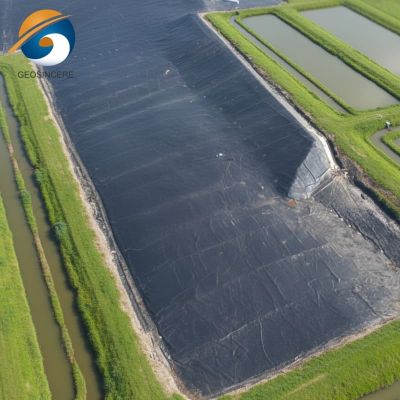
HDPE liner roll size standard export
HDPE liner rolls are high-density polyethylene sheets manufactured to precise thickness and width standards for international export. These liners serve as impermeable barriers in landfills, reservoirs, canals, and chemical containment projects, ensuring durability, chemical resistance, and ease of installation.
Technical Parameters and Specifications
| Parameter | Typical Range | Test Standard |
|---|---|---|
| Material | HDPE (high-density polyethylene) | ASTM D5199 / EN 13361 |
| Thickness | 0.5–3.0 mm | ASTM D5199 / ISO 9863 |
| Width | 4–8 m standard, up to 12 m for special export | Custom per order, ASTM D5199 |
| Length per Roll | 50–200 m depending on thickness | ASTM D5199 |
| Tensile Strength | 20–35 MPa | ASTM D6693 / ISO 527 |
| Elongation at Break | 500–800% | ASTM D6693 / ISO 527 |
| Puncture Resistance | 150–450 N | ASTM D4833 / EN 12236 |
| Hydraulic Permeability | ≤1×10⁻¹³ m/s | ASTM D5887 / ISO 11058 |
Structure and Material Composition
Polymer base: HDPE resin for mechanical strength and chemical resistance
Carbon black: UV protection and longevity in outdoor conditions
Anti-oxidants: Stabilizers to prevent aging and degradation
Optional additives: Slip agents, processing aids, and colorants
Surface: Smooth or textured depending on friction and installation needs
Manufacturing Process
HDPE resin blending with carbon black and stabilizers.
Sheet extrusion with thickness control to achieve ±5% tolerance.
Optional surface texturing or embossing.
Cooling and flattening through calibrated rollers.
Slitting to specified width and cutting to roll length.
Quality control: thickness, tensile, puncture, and seam testing.
Packaging for export: rolls wrapped in protective film and palletized.
Industry Comparison
| Material | Flexibility | Waterproofing | UV Resistance | Cost | Application |
|---|---|---|---|---|---|
| HDPE | Moderate | Excellent | High | Moderate | Landfills, ponds, chemical containment |
| LLDPE | High | Excellent | High | Moderate | Reservoirs, canals, irrigation |
| PVC | High | Good | Moderate | Low–Moderate | Decorative lining, waterproofing |
| EPDM | Very High | Good | Very High | High | Roofing and pond liners |
Application Scenarios
EPC contractors sourcing HDPE liners for landfills and mining projects
Reservoir and irrigation system projects
Chemical containment and industrial ponds
Export supply to distributors and construction firms
Infrastructure projects requiring impermeable liners
Core Pain Points and Solutions
1. Roll Size Incompatibility
Solution: Standardize roll width and length per export requirements; confirm with project specifications.
2. Mechanical Property Variability
Solution: Factory QA testing including tensile, elongation, and puncture resistance.
3. UV Degradation Risk
Solution: Pre-shipment UV exposure tests and inclusion of carbon black stabilizer.
4. Transportation Damage
Solution: Proper packaging, palletization, and protective wrapping for long-distance shipping.
Risk Warnings and Mitigation
Incorrect storage may deform rolls or damage surface.
Exposure to extreme temperatures during shipment can alter material properties.
Failure to confirm roll size standards may lead to installation issues on-site.
Incomplete pre-shipment testing increases rejection risk at project site.
Procurement and Selection Guide
Confirm project requirements: thickness, width, and length.
Select HDPE resin grade and additives suitable for application.
Request pre-shipment QC reports including tensile, puncture, and permeability tests.
Verify roll dimensions and tolerances.
Ensure packaging and palletization meet export logistics standards.
Check supplier warranty and post-delivery technical support.
Order sample rolls if possible for on-site verification before bulk purchase.
Engineering Case Example
A 15,000 m² mining containment project required HDPE liners in 6 m × 100 m rolls. Supplier pre-shipment testing verified thickness, tensile strength, puncture resistance, and UV stability. Standardized roll sizes enabled efficient installation, minimized on-site splicing, and ensured compliance with ASTM and project specifications.
FAQ – Frequently Asked Questions
1. What is the standard width for export HDPE rolls?
Typically 4–8 meters, customizable up to 12 meters per client request.
2. What is the typical roll length?
50–200 meters depending on thickness and shipment logistics.
3. Are thickness tolerances guaranteed?
Yes, typically ±5% per ASTM D5199.
4. How is UV resistance ensured?
Through carbon black addition and accelerated UV testing.
5. Can roll dimensions be customized?
Yes, width, length, and thickness can be adjusted to project needs.
6. What pre-shipment tests are recommended?
Tensile, elongation, puncture, hydraulic permeability, and seam strength.
7. How should rolls be transported?
Palletized, wrapped, and protected from heat, moisture, and mechanical damage.
8. Can distributors request sample rolls?
Yes, to verify quality and roll size before bulk purchase.
9. Are export standards compliant with ASTM/EN?
Yes, all exported HDPE rolls comply with international standards.
10. How long is the shelf life?
Typically 2–3 years if stored in controlled conditions away from UV and heat.
Request Technical Documents or Samples
Procurement managers, distributors, and EPC contractors can request technical datasheets, pre-shipment QC reports, and sample rolls. Formal quotations and bulk order verification are provided upon submission of project specifications.
Author Expertise (E-E-A-T)
Prepared by senior geosynthetics engineers with over 10 years of experience in HDPE liner manufacturing, export compliance, and B2B distribution. All technical specifications and procurement practices are verified for engineering accuracy and reliability.