

Understanding Geocell Price and Key Cost Factors in 2026
1. Introduction: What are Geocells and Why Geocell Price Matters?
Geocell, also known as cellular confinement systems, are three-dimensional honeycomb-like structures manufactured from polymeric materials such as high-density polyethylene (HDPE) or polypropylene (PP). These expandable panels are designed to confine and stabilize soil, gravel, or concrete infill materials, creating a reinforced composite layer that significantly enhances load-bearing capacity and prevents lateral movement of fill materials.
In civil engineering and environmental projects, geocells have become indispensable for applications ranging from road construction and slope protection to erosion control and retaining wall reinforcement. As infrastructure development accelerates globally and sustainable construction practices gain prominence, understanding geocell pricing has become crucial for engineers, contractors, and project managers who must balance performance requirements with budget constraints.
This comprehensive guide explores the various factors that influence geocell price, provides current market ranges for 2026, and offers practical insights to help you make informed procurement decisions for your next project.
2. What is Geocell? Understanding the Product
2.1 What are Geocells and How Do They Look?
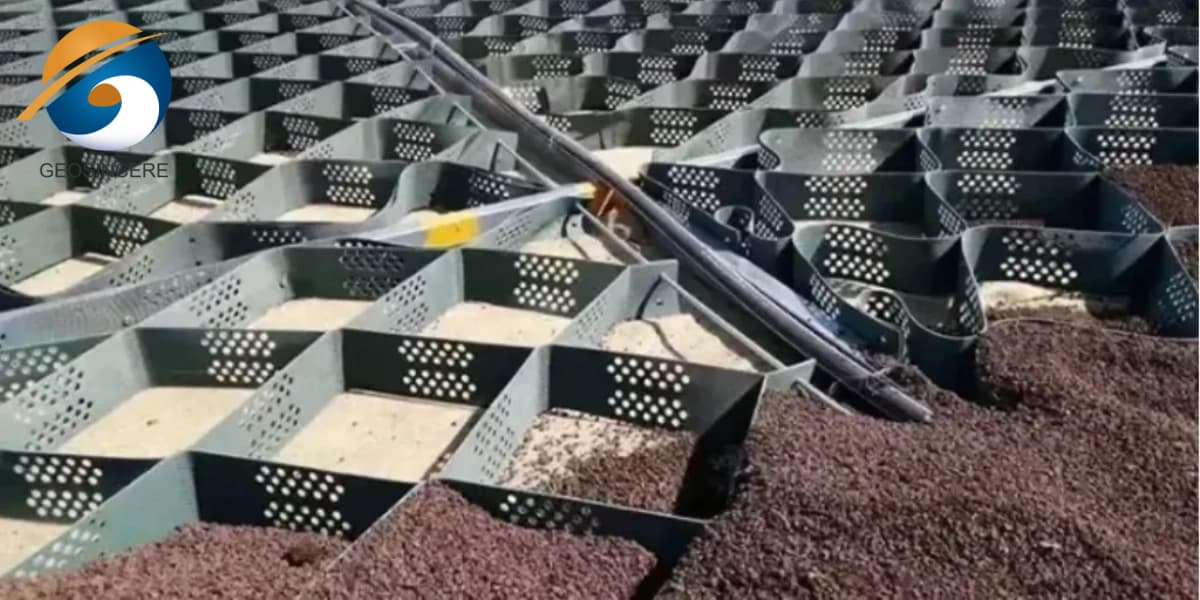
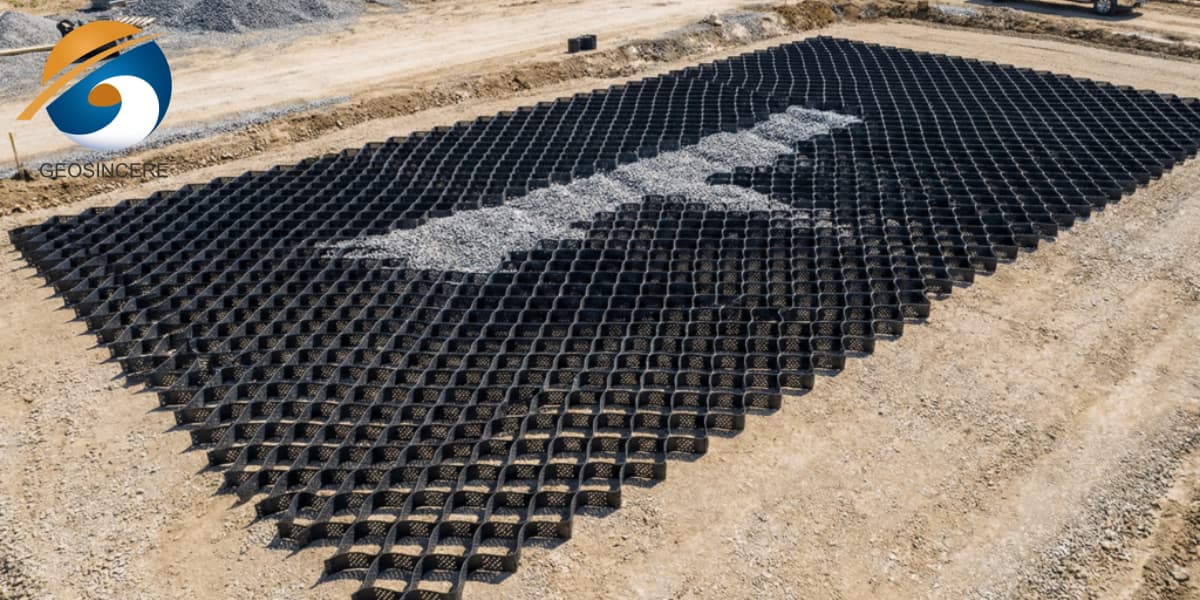
Geocells refer to geosynthetics made up of cells that are connected through polymeric strips that are welded. They are completely different from geogrids or geotextiles that only provide reinforcement in one plane, as geocells have the capability of volumetric confinement in 3D. When geo geocell is expanded at the site, they form a honeycomb pattern which traps the infill material, stops its lateral movement and by the same time, geocells can enhance the shear strength of weak subgrades by as much as 300% .
2.1.1 The Essential Components of Geocells are:
- Cell walls: Usually composed of HDPE, PP, or polyester strips with a thickness range of 1.0-1.8 mm
- Welded junctions: Those are the points where the strips are ultrasonically or thermally bonded and form the honeycomb pattern
- Perforations: Sometimes, holes are made in the cell walls for the sake of drainage and root penetration
- Expansion ratio: The panels that are in the collapsed state, when deployed at the site, have the capacity to expand from 6:1 to 8:1
2.2 Examples of Uses
Geocells can be utilized for numerous engineering and environmental projects :
- Road and Railway Structures: Providing stabilization to the base and subbase layers, cutting down the aggregate usage by 20-50%
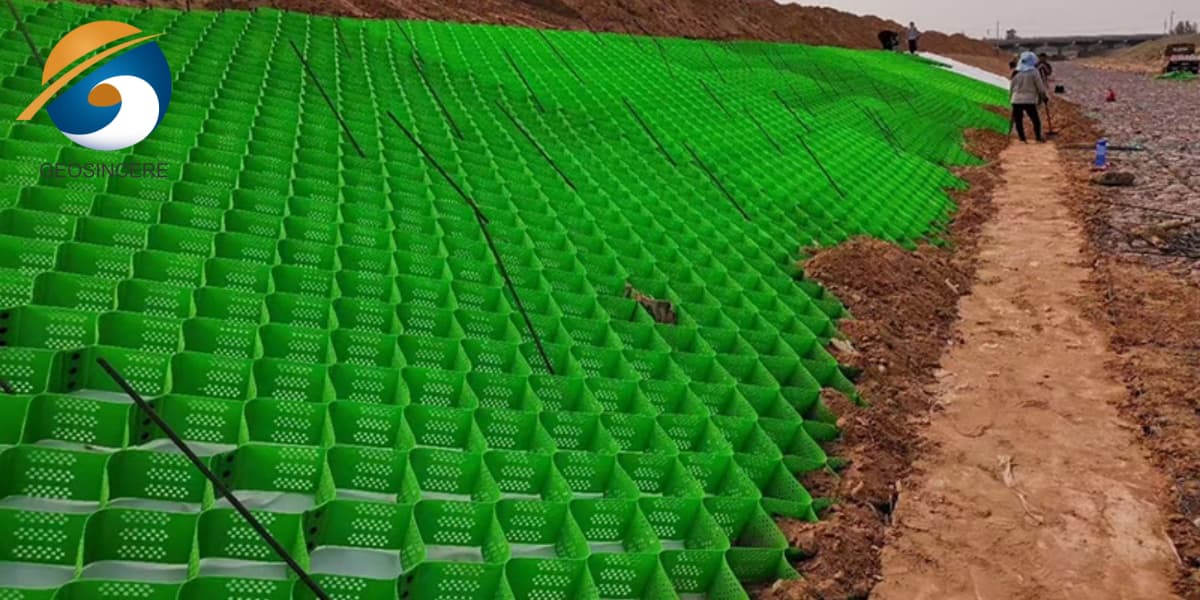
- Slope Protection: Guarding the soil from erosion and stabilizing even 1:1 slopes
- Retaining Walls: Building mechanically stabilized earth complexes for steep vertical faces
- Load Support: Strengthening working platforms for construction machinery and temporary access roads
- Channel Protection: Preventing scour and erosion by lining drainage channels and culverts
- Environmental Protection: Landfill caps, mine haul roads, and shorelines
- Tree Root Protection: Avoiding soil compaction around very sensitive root systems
2.3 An Overview of Geocell Price: Market Ranges Today
2.3.1 Price Range Overall
Geocell prices in 2026 are usually somewhere in-between $0.50 and $8.00 per square meter plus or minus depending on what specifications and order characteristics contribute to the pricing. Such a broad range mainly comes from a variety of materials, configurations, and levels of quality available worldwide .
Most projects implementing standard HDPE geocell with typical specifications and average-sized orders, present prices in the vicinity of $2.00 to $5.00 per square meter . Low-budget erosion control investors might very well be on the lookout for basic versions starting at $0.80 per square meter, while high-grade infrastructural jobs may go for materials priced north of $7.00 per square meter .
2.3.2 Market Worldwide
Geocells are an integral part of the construction industry and the worldwide market reflects this as well. As per studies conducted by the industry, the market size stood at about $2.21 billion in 2025 and is expected to increase at a compound annual growth rate of 8.1-8.5% through 2030, which would bring it to approximately $3.31 billion . One of the main reasons for such growth is the increasing infrastructure development, especially in the Asia-Pacific region, as well as the rising use of geosynthetics in civil engineering .
The Asia-Pacific is at present the biggest regional market as the demand there is largely driven by the fast infrastructure development in countries like China and India. North America and Europe come next and these markets are majorly influenced by sustainable construction practices and projects related to infrastructure renewal .
3. Principal Elements That Modify Geocell Price
Knowing the elements that impact the cost of geocells permits the cost planners to make choices that are efficient without lowering the quality. The factors below are the major cost influencers.
3.1 Geocell Material Type
More than 40-50% of the overall cost of the product can be attributed to the polymer used for the production of geocells.
3.1.1 High-Density Polyethylene (HDPE)
The most common material, priced between $0.50 and $3.50 per square meter. HDPE geocell offers excellent durability, chemical resistance, and UV stability, with service lives of 50-100 years in buried conditions. It dominates approximately 60-70% of the market due to its optimal price-performance ratio.
3.1.2 Polypropylene (PP)
Ranging from $0.40 to $2.50 per square meter, PP geocell provides a more economical option for less demanding applications. It offers good flexibility and is approximately 20% lighter than HDPE, making it suitable for temporary projects or areas requiring seismic flexibility.
3.1.3 Polyester (PET)
Priced at $1.50 to $5.00 per square meter, polyester represents the premium option for high-tensile applications. PET geocell delivers exceptional strength (100-300 kN/m tensile capacity) and hydrolysis resistance, ideal for permanent retaining walls and submerged applications.
3.1.4 Biodegradable Variants
Emerging eco-friendly options range from $0.80 to $3.00 per square meter. These starch-based materials decompose in 2-5 years and are used for temporary erosion control where vegetation establishment is the primary goal.
3.2 Cell Height and Configuration
Geocell height directly correlates with material volume and manufacturing complexity, typically accounting for 20-30% of price variation .
3.2.1 Low Height (50-100 mm)
$0.50-$1.50 per square meter. Suitable for light erosion control, surface protection, and vegetated slopes. These configurations minimize material usage and are the most economical option.
3.2.2 Medium Height (100-200 mm)
$1.00-$2.50 per square meter. The standard specification for road bases, load support, and general stabilization. Medium heights offer the best balance of performance and cost for most infrastructure applications.
3.2.3 High Height (200-300 mm)
$2.00-$5.00 per square meter. Required for heavy retaining walls, deep foundation beds, and high-load applications. The additional material volume increases both raw material costs and manufacturing time.
3.2.4 Perforation
Adding drainage holes typically increases price by 10-20% compared to non-perforated equivalents. Perforated geocell allow water flow and root penetration, essential for vegetated systems and drainage applications.
3.3 Material Thickness
The thickness of HDPE strips used in geocell erosion control construction significantly impacts both durability and price. Standard thicknesses range from 1.0 mm to 1.8 mm, with thicker walls commanding premium pricing due to increased material usage and enhanced performance characteristics.
Projects requiring high load-bearing capacity or long-term stability typically specify thicker walls. For example, highway construction with heavy vehicle traffic may require 1.5-1.8 mm thickness, while light landscaping applications may perform adequately with 1.0-1.2 mm materials.
3.4 Weld Distance and Cell Size
The distance between weld points determines individual cell dimensions and influences both performance and cost. Smaller cell sizes (tighter weld spacing) provide better confinement but require more weld points per square meter, increasing manufacturing labor and material consumption. Typical weld distances range from 330 mm to 1000 mm, with smaller spacing adding approximately 10-15% to product cost.
3.5 Project Size and Order Quantity
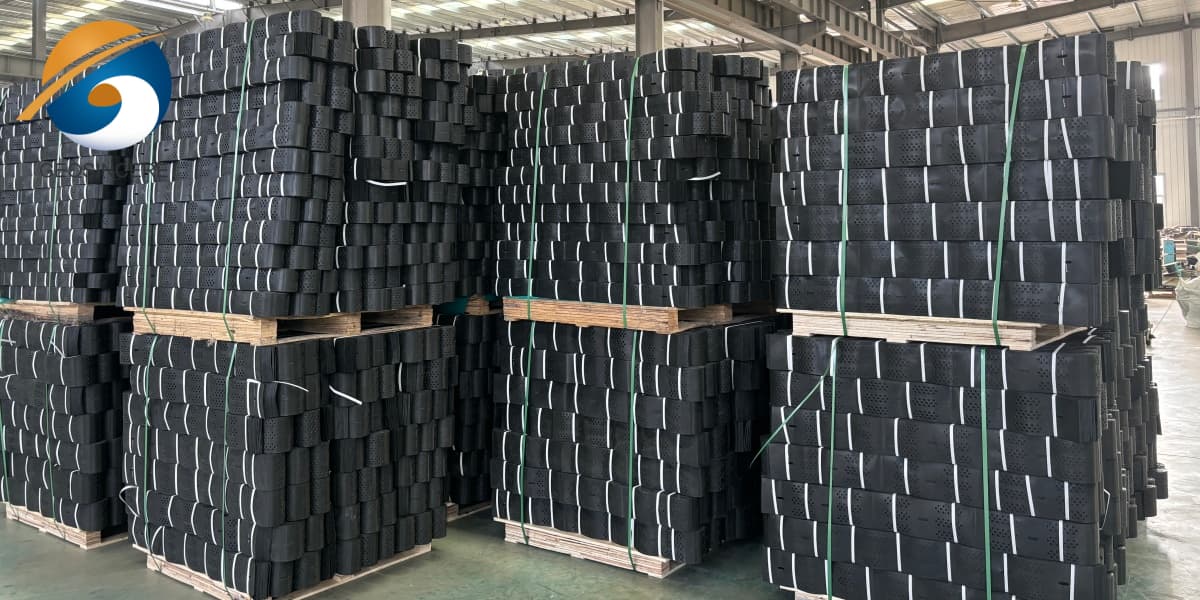
Economies of scale play a significant role in geocell pricing, with volume discounts typically ranging from 15-35% for larger orders.
3.5.1 Small Projects (<5,000 m²)
$2.00-$5.00+ per square meter. Smaller orders incur higher per-unit costs due to setup fees and less efficient production runs.
3.5.2 Medium Projects (5,000-10,000 m²)
$1.50-$4.00 per square meter. Moderate volume discounts become available at this scale.
3.5.3 Large Projects (>10,000 m²)
$1.00-$3.00 per square meter. Bulk purchasing yields the most favorable pricing, with manufacturers able to optimize production schedules and material procurement.
3.6 Customization Requirements
Standard geocell material products offer the most economical solution, while customization adds cost. Special requirements that increase price include :
- Non-standard colors: Custom coloring requires material formulation adjustments
- Special textures: Textured surfaces for enhanced friction add manufacturing complexity
- Branded printing: Company logos or project markings require additional processing
- Modified cell configurations: Non-standard dimensions may require tooling adjustments
Customized products typically command a 10-25% premium over standard equivalents, depending on the complexity of modifications .
3.7 Raw Material Market Fluctuations
Geocell prices are sensitive to polymer resin costs, which fluctuate with petrochemical market conditions. In 2025-2026, HDPE resin prices have experienced increases of 5-8% due to global supply chain factors and energy costs . These raw material fluctuations directly impact finished product pricing, with manufacturers typically adjusting quotes to reflect current resin market conditions.
3.8 Tariffs and Trade Policies
International trade dynamics significantly influence geocell pricing in global markets. Recent tariff implementations have increased costs for imported polymer resins, extrusion machinery, and fabrication equipment used in geocell manufacturing . Infrastructure projects in North America and Europe are most affected due to dependence on imported raw materials, while Asia-Pacific manufacturers face pricing pressure on exports. These trade factors typically add 5-15% to project material costs, depending on regional supply chains and tariff structures .
3.9 Additional Cost Considerations Beyond Material Price
3.9.1 Installation Costs
Material price represents only one component of total project cost. Geocell installation typically adds $0.50-$1.50 per square meter (20-40% of total project budget), covering labor, equipment, and quality control . Installation costs vary based on:
- Site accessibility and terrain conditions
- Required infill material handling and placement
- Compaction equipment requirements
- Local labor rates
- Project complexity and geometric challenges
3.9.2 Infill Material Costs
The materials used to fill geocell cells represent a significant project expense that varies widely by application :
- On-site soil: Minimal cost but limited strength for load-bearing applications
- Imported gravel/crushed stone: $15-$40 per cubic meter, providing excellent load support
- Concrete: $100-$150 per cubic meter for highest strength requirements
- Recycled aggregates: Cost-effective and environmentally beneficial where available
Proper infill selection balances performance requirements with material availability and transportation costs. Geocell HDPE can reduce infill requirements by 20-30% compared to unreinforced sections, partially offsetting higher infill material costs .
3.10 Long-Term Value Considerations
While initial material price is important, experienced project managers consider total lifecycle costs :
- Durability: Premium best geocell with 50-100 year service lives reduce replacement frequency
- Maintenance reduction: Properly designed geocell systems minimize ongoing maintenance expenses
- Material savings: Reduced aggregate thickness requirements (20-50% savings) offset higher geocell costs
- Construction speed: Faster installation reduces labor and equipment rental costs
A lower-priced geocell may prove more expensive over the project lifecycle if it requires earlier replacement or fails to perform adequately. Calculating total cost of ownership helps optimize material selection .
3.11 Geocell Price by Application: Typical Ranges
Different applications require different geocell specifications, leading to characteristic price ranges for common project types :
3.11.1 Erosion Control (Slopes and Channels)
$0.80-$2.50 per square meter. Typically uses 50-100 mm height, often perforated for vegetation, may use PP for cost efficiency.
3.11.2 Road Base Reinforcement
$2.00-$4.50 per square meter. Standard 150-200 mm height HDPE with good UV resistance, moderate perforation for drainage.
3.11.3 Retaining Walls
$3.00-$6.00 per square meter. Requires 200-300 mm height, often polyester or reinforced HDPE for high tensile strength.
3.11.4 Heavy Load Support (Mining, Ports)
$4.00-$8.00 per square meter. Premium materials with thick walls, high weld strength, and enhanced durability specifications.
3.11.5 Temporary Access Roads
$1.50-$3.50 per square meter. May use PP or lighter HDPE specifications where long-term durability is less critical.
3.11.6 Vegetated/Greening Applications
$1.00-$3.00 per square meter. Perforated designs with biodegradable options available for temporary applications.
3.12 Regional Price Variations
Geocell prices vary significantly by region due to local manufacturing capacity, raw material availability, labor costs, and transportation expenses :
3.12.1 Asia-Pacific
Generally lowest prices due to concentrated manufacturing base in China and India. Standard HDPE geocells range from $0.80-$3.00 per square meter, with significant volume discounts available .
3.12.2 North America
Moderate to premium pricing ($2.00-$6.00 per square meter) reflecting transportation costs, quality standards, and strong demand from infrastructure projects. Tariff impacts may increase prices for imported materials .
3.12.3 Europe
Premium pricing ($2.50-$7.00 per square meter) with emphasis on quality certifications and environmental standards. Strong demand for sustainable infrastructure drives innovation.
3.12.4 Middle East and Africa
Variable pricing depending on import logistics and project scale. Large infrastructure projects may achieve competitive pricing through volume procurement.
3.12.5 Latin America
Growing market with moderate pricing influenced by regional manufacturing and import costs.
4. How to Get Accurate Geocell Price?
4.1 Requesting Quotes
When soliciting geocell price quotes, provide suppliers with comprehensive project information to receive accurate, competitive pricing :
- Total area required (square meters)
- Cell height (50-300 mm specification)
- Material preference (HDPE, PP, PET, or biodegradable)
- Perforation requirements (perforated or non-perforated)
- Thickness specification (1.0-1.8 mm)
- Weld distance/cell size preferences
- UV resistance requirements (exposure duration)
- Delivery location(for freight calculation)
- Project timeline (urgency affects pricing)
- Certification requirements (ASTM, GRI, or other standards)
Conclusion
Geocell prices in 2026 reflect a complex interplay of material costs, manufacturing factors, market dynamics, and project-specific requirements. With typical ranges from $0.50 to $8.00 per square meter, understanding the factors that influence pricing enables informed decision-making that balances initial material costs with long-term project value.
For standard infrastructure applications, budget $2.00-$5.00 per square meter for quality HDPE geocells, with volume discounts available for larger projects. Remember that material price represents only one component of total project cost—installation, infill, and long-term performance considerations are equally important for project success.
As the global geocell market continues growing at 6.5-8.5% annually through 2030, driven by infrastructure development and sustainable construction practices, prices may experience moderate pressure. However, technological advancements, regional manufacturing development, and innovative materials like jute-based alternatives offer potential for cost optimization in appropriate applications .
By carefully evaluating project requirements, obtaining competitive quotes with complete specifications, and considering total lifecycle costs, engineers and contractors can optimize geocell selection to achieve both performance goals and budget objectives in their soil stabilization and erosion control projects.
Understanding Geocell Price and Key Cost Factors in 2026 helps project owners and engineers make more informed purchasing decisions, and choosing a reliable manufacturer such as Shandong Geosino New Material Co., Ltd. (GEOSINCERE Geosynthetics) ensures high-quality geocell products, competitive pricing, and professional support for various civil engineering projects.


