Why Choose Slope Protection Geocell for Erosion Control?
1. Introduction: Harnessing Soil’s Innate Strength Through Revolutionary Confinement
The battle against gravity and hydrology on sloped terrain is a constant engineering challenge. Traditional methods of slope stabilization and erosion control—such as concrete revetments, loose riprap, or even complex soil nailing—often represent a stark, expensive, and ecologically disruptive war against nature. A paradigm shift has occurred with the advent of the slope protection geocell, a three-dimensional cellular confinement system that takes a radically different approach: it doesn’t fight the soil; it empowers it. By transforming infill materials—from local soil to recycled aggregate—into a coherent, monolithic mattress, geocell technology delivers unparalleled performance, sustainability, and cost-efficiency. This definitive guide explores the mechanics, advantages, design considerations, and transformative applications of geocells, establishing them as the modern solution for building resilient, stable, and even verdant slopes.
2. Deconstructing the Slope Protection Geocell: A Masterclass in 3D Confinement Mechanics
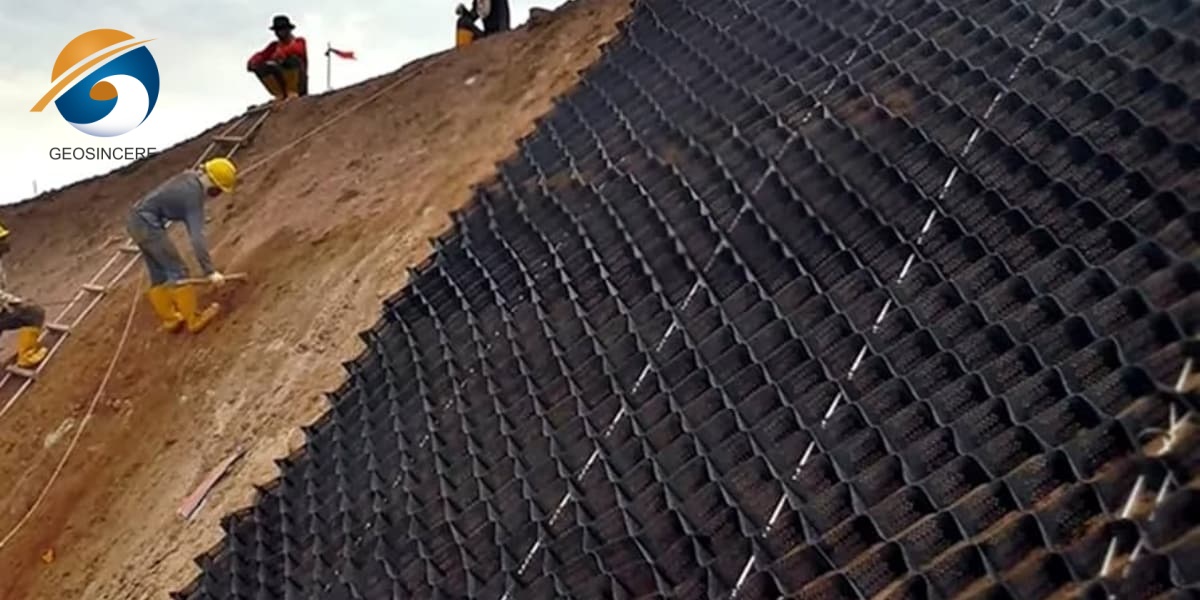
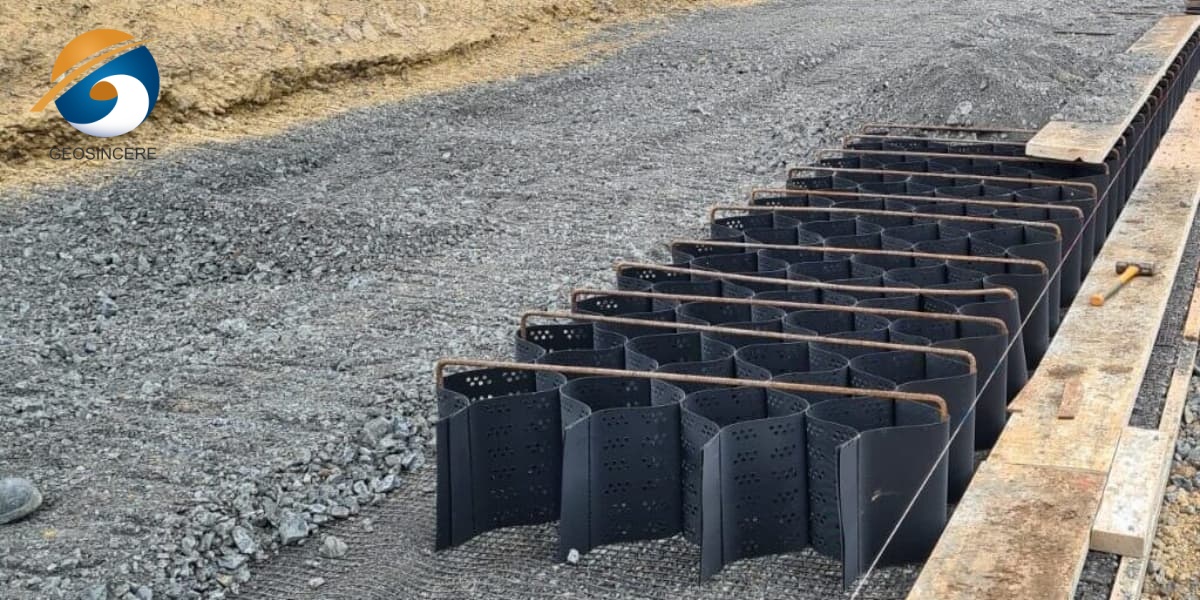
A geocell is an expandable panel manufactured from high-density polyethylene (HDPE) or novel polymer alloy strips, connected through robust ultrasonic or welded seams. When deployed on-site, it expands into a flexible, honeycomb-like web of interconnected cells. These cells are then filled with compacted, locally sourced material.
The engineering magic lies in lateral confinement. When unconfined, granular materials like soil or gravel fail under load through the outward movement of particles. The geocell wall physically restrains this movement, creating an “all-around” confining pressure within each cell. This confinement dramatically enhances the composite material’s performance:
2.1 Increased Shear Strength
The infill develops apparent cohesion, allowing it to resist sliding and rotational failures on steep slopes.
2.2 Enhanced Load-Bearing Capacity
Loads are distributed laterally through the cellular network, reducing vertical stress on the weak subgrade and creating a stable, mattress-like foundation. This is quantified by a significant improvement in the modulus of subgrade reaction.
2.3 Superior Erosion Resistance
The cell walls break up surface runoff, dissipating hydraulic energy. They also physically encapsulate and armor the infill material, preventing particle detachment even under high-velocity flow.
3. A Comparative Analysis: Why Slope Protection Geocell is the Superior Choice for Modern Projects?
3.1 vs. Concrete and Shotcrete
Concrete is rigid, brittle, environmentally ‘dead,’ and prone to cracking from settlement or frost heave. It requires complex formwork, curing time, and offers no permeability, potentially creating hydrostatic pressure behind it. Geocells, in contrast, are flexible, accommodate differential settlement, can be vegetated, are instantly permeable, and often have a lower carbon footprint due to the use of local infill.
3.2 vs. Loose Riprap
Riprap relies on the interlock of heavy, expensive stones. It can be dislodged by high water flows or vandalism, requires a thick layer, and offers no opportunity for revegetation. Geocells use smaller, cheaper, often local infill (even recycled concrete), lock it permanently in place, and provide a matrix for plant growth if desired, creating a living, self-repairing surface.
3.3 vs. Planar Geosynthetics (Geogrids/Geotextiles)
Geogrids provide excellent in-plane tensile reinforcement for deep-seated stability but offer little to no surface erosion protection. Geotextiles filter and separate but provide no structural confinement. Geocells uniquely provide both near-surface reinforcement through confinement and immediate, robust armor against erosive forces. They are often used in tandem with geogrids for deep-seated slope stability, with the geocell providing the critical erosion-resistant face.
4. Slope Protection Geocell The Multifaceted Engineering and Environmental Benefits
The advantages of a geocell system extend far beyond simple erosion control:
4.1 Unmatched Versatility
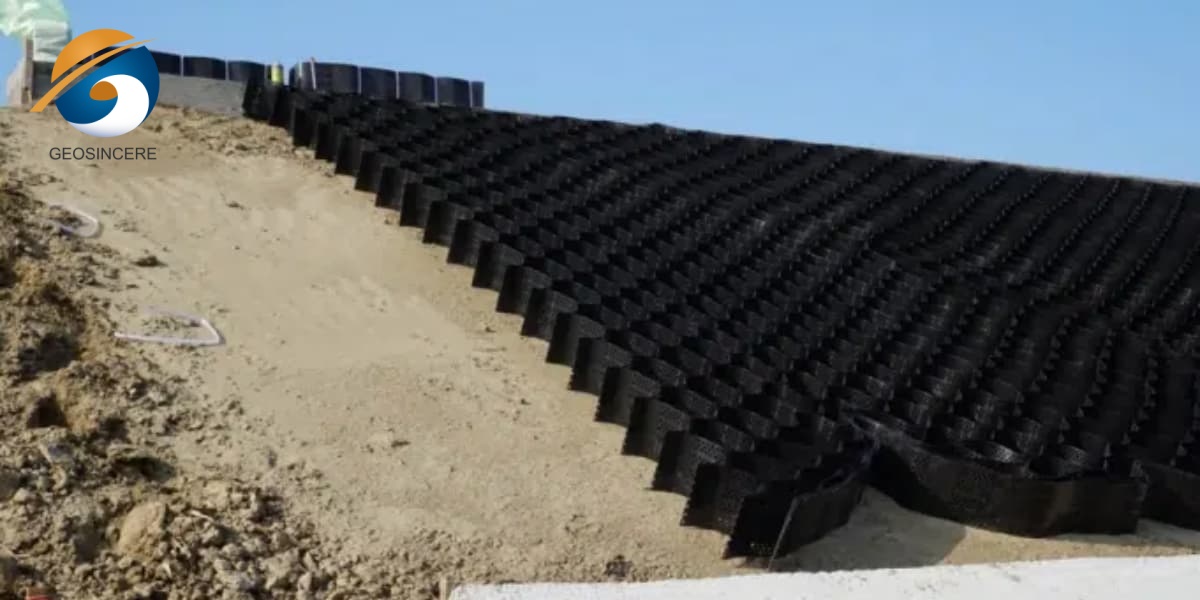
Effective on slopes from 1:1 (45°) to near-vertical applications, in channels, on shorelines, and for load support platforms.
4.2 Rapid, Simplified Construction
Lightweight panels are manually deployed, requiring minimal heavy equipment. Installation is fast and not weather-sensitive in the way concrete pours are.
4.3 Significant Cost Savings
Reduces or eliminates the need for quarried, large-diameter riprap. Enables the use of low-cost, on-site or recycled fill materials (e.g., sand, clay, crushed concrete). Lowers transportation and placement costs.
4.4 Durability and Longevity
Made from UV-stabilized HDPE, geocells are resistant to chemical, biological, and environmental degradation, with design lives exceeding 75 years in many applications.
4.5 Ecological Enhancement
The system is the ideal medium for “green engineering.” Cells can be filled with topsoil and hydroseeded, establishing deep-rooted vegetation that further binds the slope, manages stormwater through evapotranspiration, and creates vital wildlife habitat. This meets stringent environmental regulations and improves aesthetics.
5. Slope Protection Geocell Detailed Design Methodology and Implementation Strategy
5.1 A successful geocell project follows a systematic engineering approach:
Geotechnical Investigation: A thorough analysis of the in-situ soil, groundwater conditions, slope geometry, and potential failure modes is the non-negotiable first step. This informs the overall stability design.
5.2 System Design:
5.2.1 Global Stability
For high or critical slopes, a geogrid-reinforced soil structure may be designed for deep internal stability, with the geocell serving as the erosion-resistant facing.
5.2.2 Local Stability & Erosion Design
The geocell layer itself is designed to resist surface erosion and shallow slips. Key design parameters include cell depth (100mm to 300mm), seam strength (perimeter tensile strength), and the selection of infill material based on its angle of internal friction and durability.
5.2.3 Hydraulic Design
For channels or shorelines, calculations are performed to ensure the system can withstand the design flow velocity and shear stress without failure.
5.2.4 Material Selection
Choosing the right geocell is critical. Key factors include:
5.2.5 Polymer Quality
Virgin, stress-crack-resistant HDPE resin is essential.
5.2.6 Seam Strength
The weakest link; must be significantly higher than the tensile strength of the cell wall.
5.2.7 Cell Size and Depth
Dictated by the infill gradation and required surface armor thickness.
6. Slope Protection Geocell Step-by-Step Installation Protocol
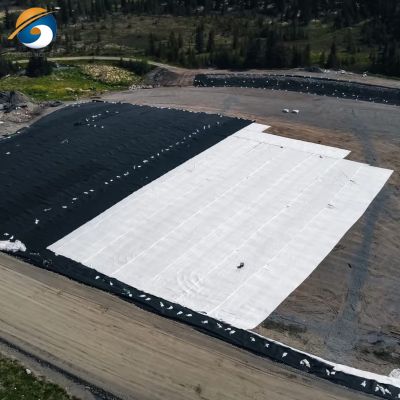
Step 1: Site Preparation. Slope is graded to the desired shape and compacted. A non-woven geotextile is often placed as a separation/filtration layer on fine-grained soils.
Step 2: Anchor and Deploy. The geocell panels are anchored at the crest of the slope (often in a small trench) and expanded downslope. Adjacent panels are connected using provided zip-ties or J-hooks.
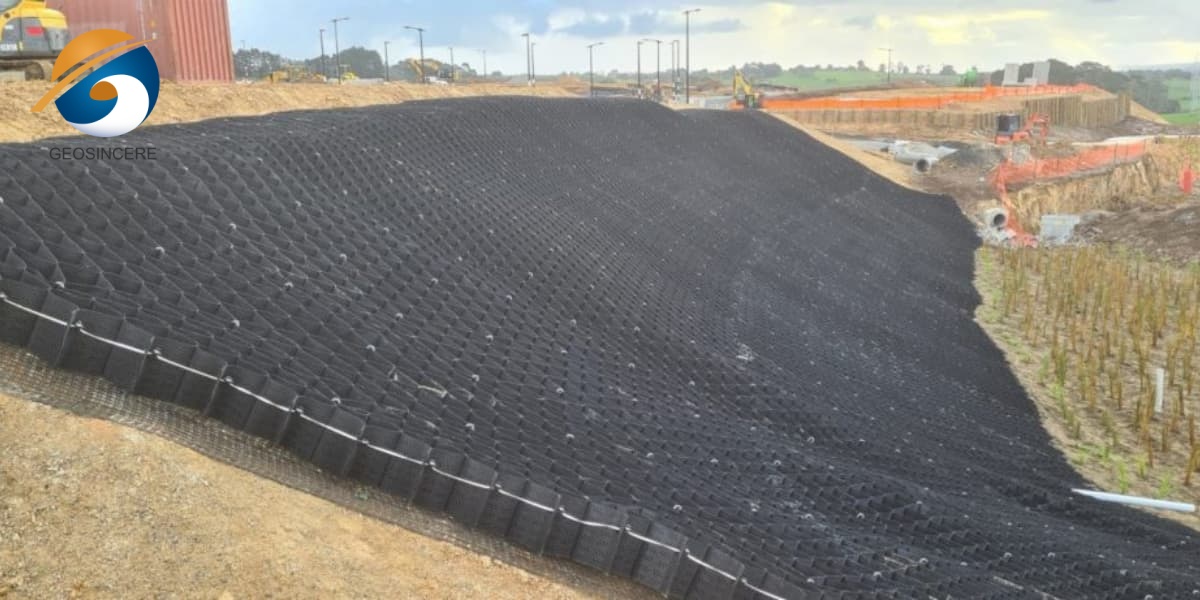
Step 3: Infill Placement. The selected material is placed into the cells, typically from the bottom up to prevent panel distortion. It is compacted in lifts to achieve maximum density and interlock. Overfilling by 25-50mm creates a protective “armor crest” above the cell walls.
Step 4: Vegetation (If Part of Design). For green slopes, a soil infill is used, followed by hydroseeding, planting of plugs, or installation of pre-grown erosion control mats.
7. Slope Protection Geocell Proven Applications Transforming Industries
7.1 Transportation
Stabilizing embankments along highways and railways, protecting cut-and-fill slopes from erosion and shallow failures.
7.2 Water Resources
Lining drainage channels, spillways, and riverbanks; protecting dam faces and reservoir shorelines from wave action.
7.3 Mining & Site Restoration
Stabilizing steep slopes on tailings dams and mine site rehabilitation projects, facilitating rapid revegetation and closure.
7.4 Coastal Engineering
A “softer” alternative to hard armoring, used in revetments and dune stabilization to dissipate wave energy while allowing ecological function.
7.5 Military & Humanitarian Construction
Rapidly creating stable platforms for temporary roads and structures on weak soils in remote locations.
8. Slope Protection Geocell The Life-Cycle Perspective: Building for the Future
The true value of a geocell slope protection system is realized over its entire life cycle. Its durability minimizes inspection and maintenance costs. Its flexibility allows it to adapt to minor ground movements without catastrophic failure. Most importantly, its ability to integrate vegetation creates a slope that grows stronger over time as root systems develop, making it a truly sustainable and resilient infrastructure investment. It is a technology that aligns economic pragmatism with environmental responsibility.
9. Conclusion: The Definitive Solution for Resilient, Living Slopes
The slope protection geocell is more than a product; it is a comprehensive engineered system that represents the forefront of geotechnical and ecological design. It provides a powerful, cost-effective, and aesthetically pleasing answer to the age-old problems of slope instability and erosion. By confining and reinforcing common materials, it unlocks their hidden potential, turning a problem—weak soil—into the primary solution. For engineers, landscape architects, and project owners seeking a future-proof, high-performance, and sustainable answer to slope challenges, the geocell system is not just an option; it is the definitive choice for building slopes that are not only stable but truly alive.
Transform your slope stability and erosion control projects with our Shandong Geosino New Material Co., Ltd. (GEOSINCERE Geosynthetics) engineered geocell systems. From technical design software and CAD details to on-site installation supervision, our expert team provides end-to-end support. Request a project-specific design proposal and see how cellular confinement can deliver superior performance and savings on your next project.