The Essential Guide to Geomembrana HDPE 30 mils
In the field of geosynthetics, geomembrana hdpe have profoundly changed the containment and barrier systems. Among different available thicknesses, the geomembrana HDPE 30 mils is one of the most versatile and reliable ones. A "mil" is a measure unit that's one-thousandth of an inch, so 30 mils equal 0.75 millimeters. The specific thickness is a great compromise between mechanical strength, flexibility, and cost, thus it is a widely used choice for numerous applications. This paper examines the makeup, characteristics, production, uses, and installation of the geomembrana HDPE 30 mils while focusing on its importance in the latest environmental and civil engineering projects.

1. Geomembrana HDPE 30 mils Material Composition and Fundamental Properties
HDPE is a polymer derived from petroleum that has a very high strength-to-density ratio. Geomembranes of HDPE are made from specially formulated resins, to which additives such as carbon black (for UV protection), antioxidants, and thermal stabilizers are added. The 30 mil thickness is designed to provide an excellent combination of characteristics:
1.1 Impermeability
This is the main function. HDPE has a very low permeability coefficient, which means it acts as a perfect barrier to liquids (water, leachate, chemicals) and gases (for example, methane). The 30-mil thickness will still prevent diffusion in the very long term.
1.2 Chemical Resistance
A good resistance to a variety of acids, alkalis, and industrial chemicals is a characteristic of HDPE. Therefore, it is a good material for landfills and chemical containment where conditions are very harsh. Environmental stress cracking, biological degradation, and UV radiation can be resisted by a properly formulated and installed 30 mil geomembrane which can call on the warranty for more than 30 years.
1.3 Chemical Resistance
HDPE has excellent resistance to acids, alkalis, and industrial chemicals. This makes it the right choice for environments like chemical containment and landfills.
1.4 Mechanical Strength
This geomembrana 30 mils thickness offers a very good tensile strength, tear resistance, and puncture resistance. It is even good enough to sustain the action of a significant subsidence, overburden pressure, and installation stresses.
1.5 Cost-Effectiveness
The 30-mil gauge is a cheaper option than larger thicknesses like 60 or 80 mils which are unnecessarily thick for some projects. This is why it is often the go-to material for a cost-effective implementation of overall project plans.
2. Geomembrana HDPE 30 mils Manufacturing Process: From Resin to Liner
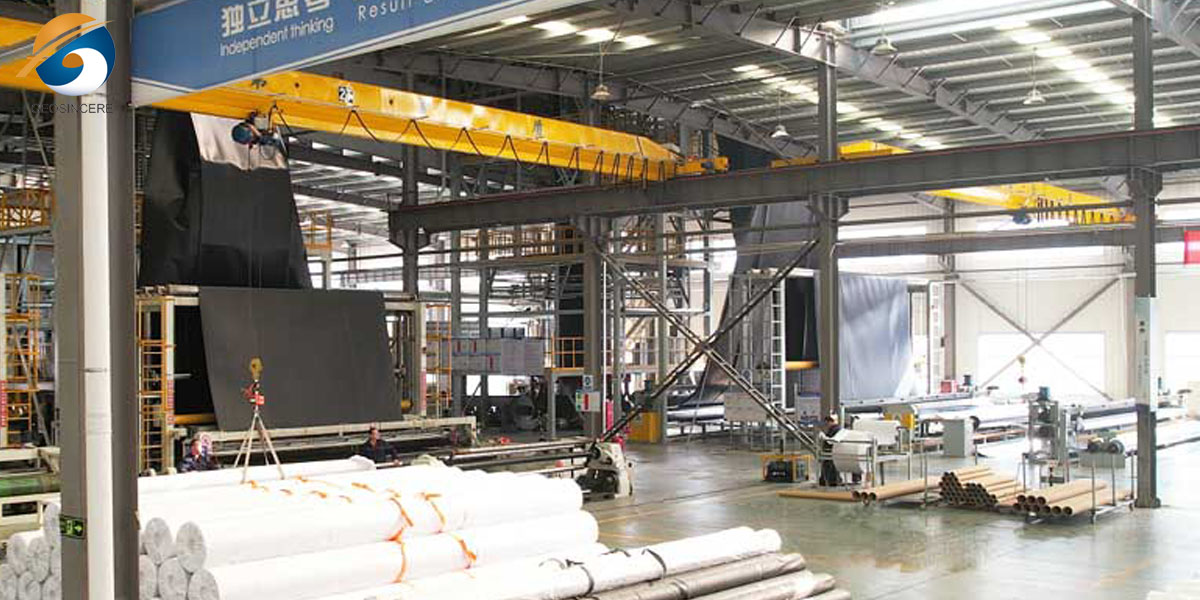
Generally, the flat die extrusion process is the method used for the making of geomembrana HDPE 30 mils. It is very useful as it results in large pieces of uniform sheets.
2.1 Resin Blending
Virgin HDPE resin pellets are mixed with carbon black (2-3% for UV protection) and stabilizers.
2.2 Extrusion
The mixture is heated until it melts and then it is reshaped as a sheet of liquid metal that is very precise in terms of thickness by passage through the flat die.
2.3 Calendering and Cooling
The geomembrane sheet is first passed through calendering rolls which set the 30-mil thickness and then through a series of cooling rolls.
2.4 Trimming and Rolling
The trimmed cooled sheet is rolled into a very large roll and pattern as per the requirement. Usually, the width is 5-10 meters. The weight of these rolls can go to till several tons, which means there will be minimum field seams during shipment.

3. Common Uses of Geomembrana HDPE 30 mils
With its balanced combination of properties, the 30 mil HDPE geomembrane is used in various field applications, some of which are listed below:
3.1 Landfill Liners and Caps
30 mils hdpe liner is among the most common and important applications. Here it is used as a primary or secondary liner whose main purpose is to stop leachate from contaminating the groundwater. Also, it can be used as the final cap to close landfills, at which the main focus is on infiltration control and gas emissions.
3.2 Water and Liquid Containment
Potable water reservoirs, irrigation canals, aquaculture ponds, and firewater retention ponds are the primary areas where this product is greatly beneficial. Geomembrane liner is impermeability property highly contributes to the maximum water conservation.
3.3 Mining and Industrial Applications
The hdpe geomembrane product can be utilized for heap leach pads, tailings impoundments, and process water containment, where resistance to chemical solutions is a necessity.
3.4 Wastewater and Lagoon Liners
This is a geomembrane sheet material that lines anaerobic digesters, equalization tanks, and treatment lagoons in both municipal and industrial facilities.
3.5 Secondary Containment
This is a 30 mil hdpe liner material in which fuel storage tanks are placed above and industrial plants are surrounded with it to prevent soil and groundwater contamination in case of accidental spills.
3.6 Agricultural and Aquaculture
Lined canals, manure storage lagoons, and decorative ponds are the places where this product is used.
4. Geomembrana HDPE 30 mils Installation: A Critical Determinant of Performance
The naturally excellent qualities of the 30 mils geomembrane can only be completely utilized with a very careful installation. The process comprises several vital steps:
4.1 Subgrade Preparation
To avoid the risk of a puncture, the soil under the hdpe geomembrane liner needs to be compacted, even, and clear of sharp rocks, roots, or other debris. To provide an extra layer of protection, a geotextile cushion is sometimes applied.
4.2 Panel Deployment
Rolls of 30 mil geomembrane liner is unrolled and positioned according to the design layout, allowing for thermal expansion/contraction.
4.3 Seaming
This is the most crucial aspect. Making seams is primarily done using the dual-track hot wedge fusion method. The overlapping HDPE sheets are melted by a heated wedge, then the sheets are pressed together by rollers that are cooled. The two air channels created between the weld tracks allow for non-destructive air pressure testing to verify seam integrity.
4.4 Testing and Inspection
Each linear inch of the seam is subjected to testing, the usual method in the field being air pressure testing. Sample seams are also subjected to destructive shear and peel testing. The entire liner is checked for defects.
4.5 Anchorage and Cover
Perimeter trenches are used for securing the impermeable geomembrane. Depending on the situation, it might be covered with a protective layer (e.g., soil, geotextile) or allowed to remain exposed.

5. Geomembrana HDPE 30 mils Advantages and Limitations
5.1 Geomembrana HDPE 30 mils Advantages
Well established long-term performance and recognized by the industry.
Outstanding chemical and UV resistance.
Because of its light weight, the product has a very good durability and puncture resistance.
Compared to thicker or other polymer liners, the material cost is relatively lower.
The geomembrana product is also offered in very large panels that substantially reduce the number of seams in the field.
5.2 Geomembrana HDPE 30 mils Limitations
- Stiffness: HDPE is not as flexible as materials such as PVC or LLDPE, thus it is less ideal for use with very irregular subgrades unless the subgrade is well prepared.
- Stress Cracking: The impermeable geomembrane liner may develop stress cracks when under a prolonged tensile stress and in the presence of certain chemicals, however, the resins used nowadays are very resistant to this.
- Seaming Expertise: Demands highly trained personnel and specialized tools; poor seaming is the major reason for liner failure.
- Thermal Expansion: This hdpe liner sheet material has a relatively high thermal expansion coefficient, thus the installer needs to provide some slack for temperature variations.
6. Geomembrana HDPE 30 mils Comparison with Other Thicknesses and Materials
Usually, the decision to select 30 mils is based on the exact requirements of the project:
6.1 Vs. Thinner HDPE (e.g., 20 mil)
30 mils gives you more than double the strength to puncture and tear resistance, which is very important for demanding subgrades and the long-term planting of applications.
6.2 Vs. Thicker HDPE (e.g., 60, 80 mil)
Thicker liners are used for very severe conditions (deep landfills, heavy & sharp overburden). 30 mil offers a more budget-friendly option for moderate-stress situations.
6.3 Vs. LLDPE or fPP Geomembranes
These films are generally more flexible and have a better conforming ability, but they are generally less resistant to chemicals than HDPE and have higher permeability. The HDPE 30 mil is selected because of its outstanding barrier capability and durability.
Conclusion
Geomembrana HDPE 30 mils represents the implementation of material technology to achieve environmental goals and industrial safety. Choosing it is a key engineering decision, where the 0.75-millimeter protective sheet goes beyond its physical dimensions to become a major defense barrier. As projects continue to grow in scale and complexity - be it mining operations spanning continents or renewable energy installations requiring large-scale stormwater management - the trustworthiness and consistency of 30-mil HDPE are becoming gradually more appreciated. The product is no longer just a component of containment; it becomes a facilitator of safe and sustainable resource development, site remediation, and freshwater conservation in a world where water is becoming increasingly scarce.
Going on, the fate of HDPE 30-mil geomembranes is very much linked to the rise of sustainability and digitalization. Today, manufacturers are integrating recycled HDPE content into liner formulations to meet circular economy principles while maintaining performance; however, virgin resin still dominates primary containment due to consistency requirements. Besides that, the combination of geosynthetics is also on the rise. A "smart liner" is envisioned, whereby 30-mil HDPE membranes would have sensor networks integrated that would continuously monitor strain, temperature, and overall integrity; such systems are transitioning from research to experimental piloting. It allows for maintenance that is predictive and leak detection that is instantaneous, thus turning the liner from a passive barrier into an active monitoring system. This technological advancement can help further extend the already great lifetime and dependability of the material by providing data-backed assurance for decades.
In the final analysis, the long-lasting dominance of the 30-mil HDPE geomembrane has less to do with the technical data on the specification sheet. It is a result of a mature and robust ecosystem--components being consistent raw material suppliers, certified manufacturers, design engineers with a wealth of experience, and highly skilled installers--that have collectively, and proven, delivered performance in the field for decades. Such a track record serves to lower project risk and is a source of confidence for regulators, investors, and the public. Thus, the decision to specify a geomembrana HDPE 30 mils equates to buying not only a top-class polymer sheet but this entire expertise ecosystem. It keeps being the yardstick by which newer or alternative lining materials are compared; a dependable and indispensable solution paving the way toward a more resilient and safer infrastructure for the next generations.
Choose a reliable supplier to quote price for you :
Shandong Geosino New Material Co., Ltd. (GEOSINCERE Geosynthetics) has been keeping on investing in technological innovation, manufacturing facilities improvement and turnkey engineering abilities. We have invested 10 million dollars into our manufacturing factory which is equipped with state-of-the-art automatic production lines to manufacture high quality HDPE geomembranes and other geosynthetics with optimized processes. Our extensive lines of geosynthetics products are well known for their ensured quality, high performance, excellent durability and best cost effectiveness.
GEOSINCERE brand HDPE geomembranes and other geosynthetics products and solutions can meet your requirements by our solid technologies, innovative engineering solutions and excellent customer services. GEOSINCERE always tries our best to solve the most complex civil, mining and environmental challenges with our innovative and high performance geosynthetic products. Quality assurance, factory price and fast delivery time are our competitive advantages.