

When Should You Choose Textured Lining HDPE Over Smooth Lining HDPE?
In the realm of geosynthetic containment solutions, lining HDPE is broadly considered to be the highly reliable material for long-term, impermeable barriers. However, an essential point of decision is frequently made at the very beginning of the specification process: should it be smooth or textured? Both by design share the same backbone product with regard to the chemical resistance and durability of HDPE but their performance varies significantly when it comes to the application geometry and interface conditions. An incorrect choice may result in expensive damages including the liner sliding on slopes or composite systems becoming unstable. This all-inclusive guide will take you through the engineering considerations of selecting a textured lining HDPE over a smooth one so that you have a solid base for the entire project.
1. Understanding the Lining HDPE Fundamental Difference: It’s All About Friction
Essentially, when it comes to choosing between textured and smooth HDPE, it is really about the interface shear strength.
1.1 Smooth Lining HDPE
A smooth HDPE lining gives a very low-friction, mostly inert surface. Its main way of interacting with the neighboring materials (soil, geotextiles, geonets) is through adhesion and a limited friction that, if the materials are wet, can become considerably lower.
1.2 Textured Lining HDPE
A textured HDPE liner has a rough, uneven surface pattern that is formed during the production process (usually either through co-extrusion or spray-on methods when the blown film is being made). This roughness physically meshes with the materials that are in contact with it and hence, a much higher angle of internal friction (Φ) can be achieved at their interface. The easiest way to picture it is to compare walking on an icy and slippery hill with walking on a gravelly and rough one.
This one feature—significantly increased interface shear strength—drives the whole decision-making chart.
2. Key Application Scenarios Demanding Textured Lining HDPE
Below are the real-world defining situations where putting the textured HDPE to work is not only highly beneficial but also critically mandatory to the success of the project.
2.1 Steep Side Slopes and Embankments
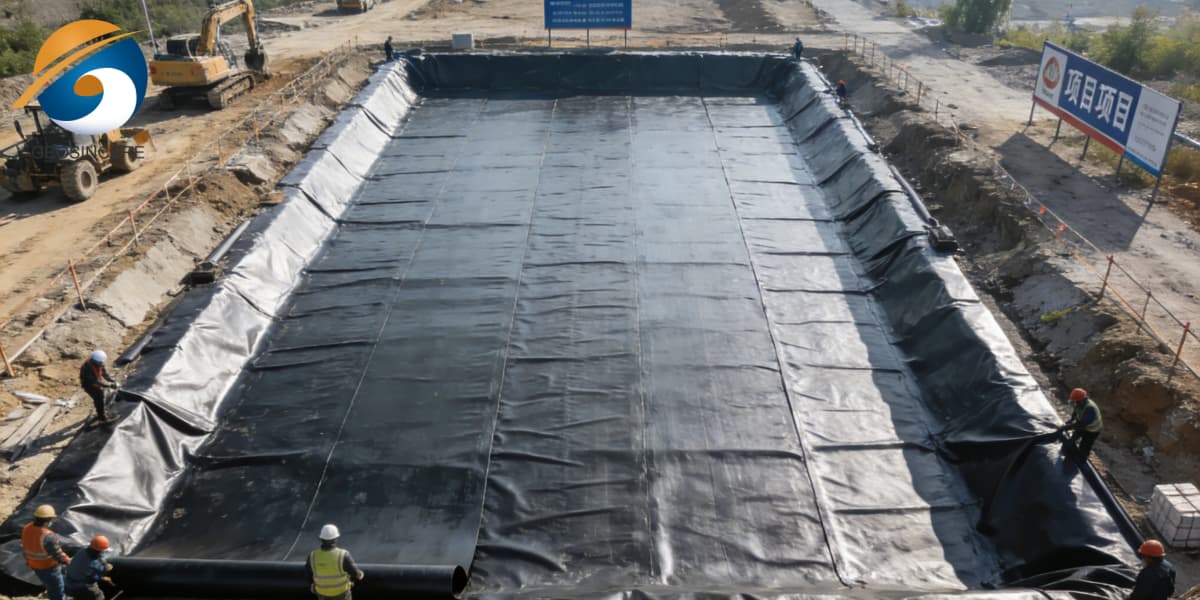
On a steep side slope and embankments, there is the greatest gravitational pull on the hdpe pond liner as well as other materials above it (like protective soil cover, drainage gravel). A smooth liner with a very low friction coefficient thus, to some extent, may become a plane of failure. Overlying materials, in this case soil or rock, can slide and the hdpe textured geomembrane can get deformed, stressed, and even pulled out from the anchor trenches.
2.1.1 The Textured Solution:
The rough surface grips the subgrade below and the cover soil above, effectively tying the system together. Textured hdpe sheet transfers shear forces through the liner plane, allowing for the construction of stable, steeper slopes (often up to 3H:1V or steeper, depending on design). This maximizes containment volume and minimizes land use.
2.2 Lining Systems with Overlying Geosynthetics (Composite Liners)
It is barely the case nowadays that a containment facility decides to install a geomembrane only. This is usually a part of a Composite Liner System (for example, a geomembrane over a compacted clay liner) or a Geosynthetic Composite geomembrane system involving layers like geonets (for drainage) or geotextiles (for protection and filtration).
2.2.1 Smooth-on-Smooth Instability:
Attaching a smooth geonet or geotextile to a smooth geomembrane generates a layer of contact with hardly any resistance. When a load is exerted on it or it is placed on a slope, these layers may easily slide against each other, which will cause the breakdown of the drainage channels and the overall system.
2.2.2 The Textured Solution
The textured geomembrane offers a “tooth” that helps to tightly fix the geosynthetic above. This "tooth" plays a vital role in the successful anchoring of drainage geonets and the prevention of the bunching up or shifting of protective geotextiles. When it comes to double-lined facilities, the textured side of the primary liner also increases friction with the secondary leak detection layer.
2.3 Applications with Direct Soil or Aggregate Cover
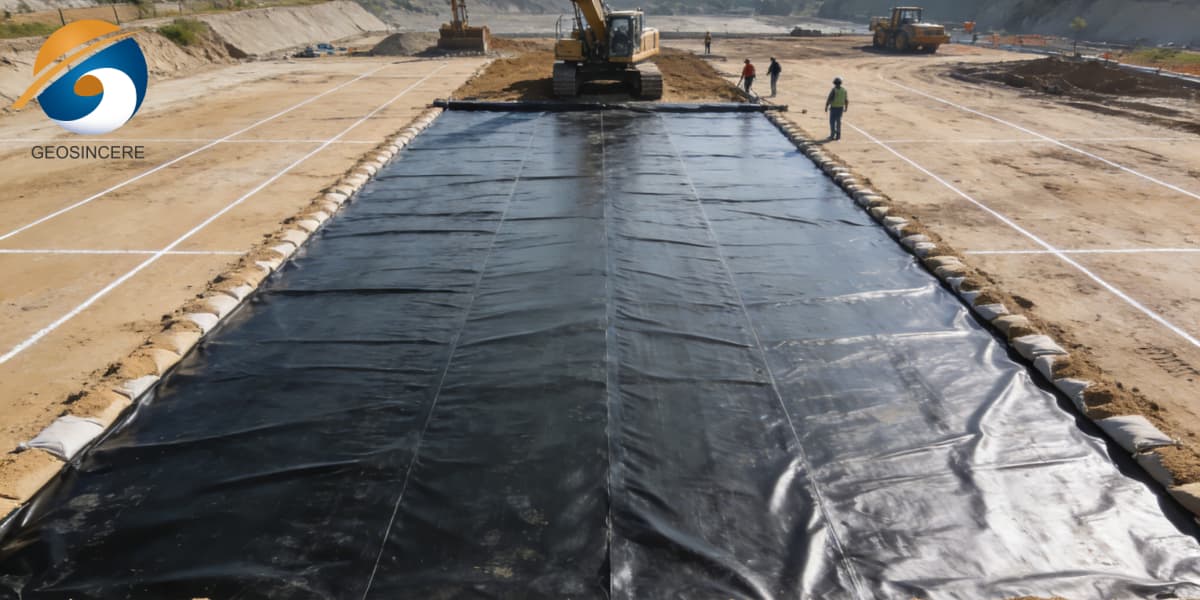
In water reservoirs for drinking, stormwater retention ponds, or canal lining projects, the HDPE liner is usually covered directly with soil, rip-rap, or concrete for protection and ballast. A smooth liner underneath a saturated cover soil forms a very high-risk interface for slippage.
2.3.1 The Textured Solution
The texture offers an effective locking mechanism between the cover material and the liner. It stops the erosion of the soil cover down the slope, helps in maintaining the design cross- sections in canals, and in securing rip- rap armor units. The stability over the long term is dependent on the texture being in place, especially in the case of fluctuating water levels, changing soil saturation, and weight.
2.4 HVAC Installation, Where Margin of Safety is Paramount
Instead of calculations theoretically deeming a smooth liner stable on moderate slopes, prudent engineers usually specify a textured HDPE liner to provide for:
- Provision for possible differences between the as-built subgrade and the original design.
- Consideration of the possible effects of moisture changes over time in soils adjacent to the liner.
- Taking into account the possibility of great dynamics in shear loads triggered by earthquakes.
The fallout from such failure. The unaccounted cost of the remedy to a liner slide in a landfill cover or a mining heap leach pad far outweighs the insignificant incremental material cost of textured HDPE.
3. When Smooth Lining HDPE Remains the Preferred Choice?
In fact, it is as essential to know the use cases of smooth HDPE, where it is just as good or even better than the alternative, such as:
- Flat Base Liners:On flat base liners where primary stresses are compressive, not shear-based.
- Floating Covers:Tanks or reservoirs where the smooth surface is beneficial.
- Applications with Liquid Contact Only:Where the liner is not in contact with solid soils or geosynthetics on both sides (e.g., some secondary containment).
- Tunnel and Under-ground Applications:In situations where the liner is either concreted or grouted thus hooking the interface concerns.
- Cost-Sensitive Projects with No Slope or Stability Issues:Projects where cost-efficiency is the primary goal and engineering has thoroughly proven the absence of shear demand.
4. Lining HDPE Technical Considerations and Trade-offs
Making a decision between the two does entail more than ticking a single box. Knowing the trade-offs will help you decide how far your specification is informed.
4.1 Thickness and Strength
Texture is a layer that adds to the total surface. For example, a 1.5mm textured geomembrane might have a smooth core of 1.3mm with a 0.2mm textured layer on top. Make sure that the specifications include a minimum core thickness to ensure that the HDPE sheet itself will be structurally sound.
4.2 Chemical Resistance
The textured layer gives a higher surface area. Even though the resin is the same, in highly aggressive chemical environments, some engineers prefer smooth surfaces for ease of cleaning or visual inspection although chemically the resistance does not really change.
4.3 Seaming Complexity
More care is required when seaming textured geomembranes. Basically, the little bumps on the textured geomembrane have to be completely melted during the dual hot-wedge welding process to form a continuous, strong, and impermeable seam. Working with textured material, therefore, entails the technicians having to be quite specifically trained.
4.4 Interface Friction Testing
Guessing the values is not an option. The design needs to be done on the basis of project-specific interface shear testing (e.g., ASTM D5321 or similar). Determining the friction angle (Φ) of textured HDPE against sand, clay, or geotextile by direct experience is one of the ways to get reliable data for stability modeling.
4.5 Durability
First class co-extruded texturing is inseparable from the sheet and does not become detached. It keeps its frictional characteristics for the long haul thus the high density polyethylene pond liner and the texturing can be expected to have the same service life.
5. The Decision Framework: Lining HDPE A Step-by-Step Guide
Use this checklist to guide your specification:
5.1 Analyze the Geometry
Is there a slope that is steeper than 10H:1V? If YES.Strong candidate for Textured.
5.2 Map the Cross-Section
Does the liner interface with soil, gravel, or other geosynthetics on an inclined plane? If YES.Strong candidate for Textured.
5.3 Assess the Risk
What would be the result of interfacial slippage? (Environmental damage, lost capacity, repair cost). If HIGH.Textured to be specified for a higher safety factor.
5.4 Review the Budget
Is the additional cost of textured HDPE going to jeopardize the implementation of other essential project elements? If NO (usually the case as material cost is a small fraction of total installed cost) .Specify Textured where applicable.
5.5 Consult the Detailed Design
This is the definite phase. To do so, a slope stability analysis using site-specific soil and interface parameters needs to be done by a geotechnical engineer or geosynthetics specialist.
Conclusion: An Investment in Stability
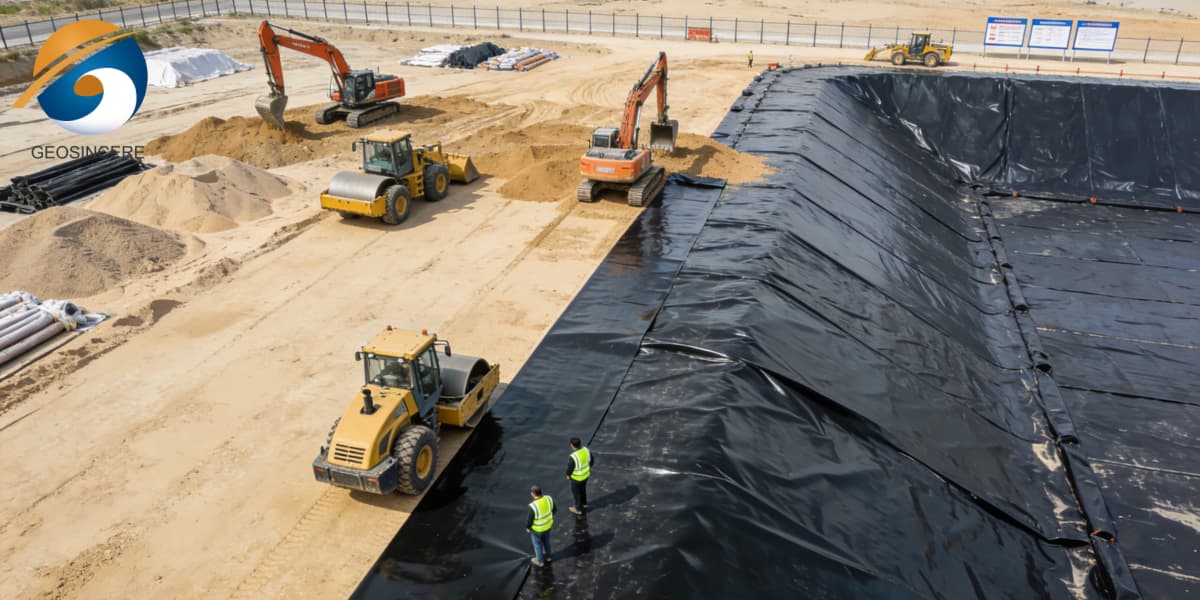
Choosing textured or smooth lining HDPE is basically an engineering decision focused on stability. Obviously, smooth HDPE is suitable for passive, flat, or submerged applications, while textured HDPE is absolutely necessary when the liner is subjected to gravity-induced shear forces.
Opting for textured HDPE liner in slopes and composite systems is not a needless extravagance but rather a direct purchase of the long-term structural integrity and performance of the containment. Furthermore, it essentially turns the geomembrane into a necessary, stabilizing element of the whole soil-geosynthetic system, thus preventing the risk of costly, disruptive failures that would otherwise occur.
Especially when dealing with critical environmental containment projects, the higher safety and performance that Shandong Geosino New Material Co., Ltd. (GEOSINCERE Geosynthetics) textured lining hdpe offers will make it the sensible and professional choice.


